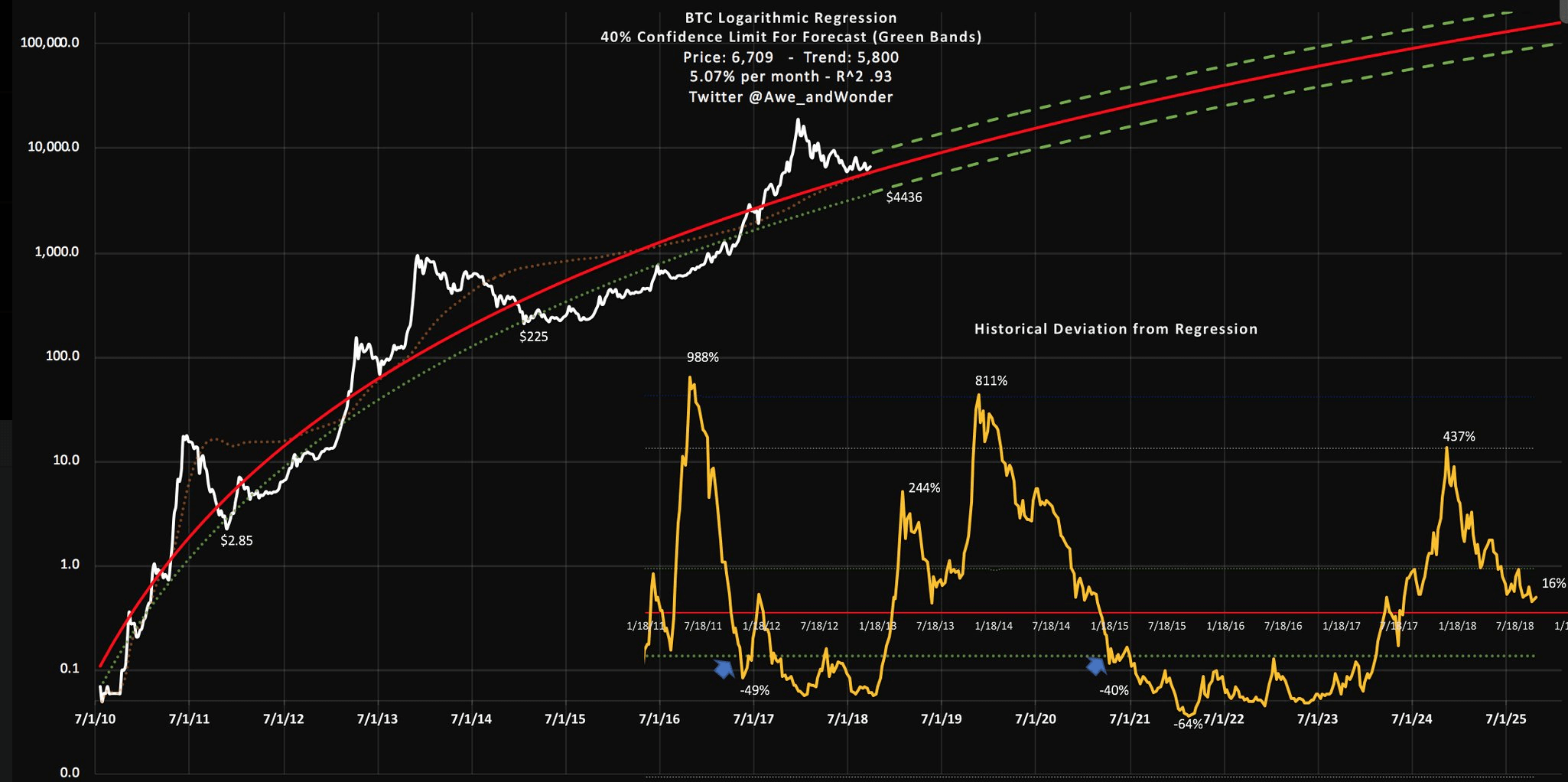
BTC/USD is doing just fine. Nobody who knows anything about anything made any kinds of plans involving $20,000 Bitcoin. At ~$4k, it's still 10x where it was 2 years ago. Anybody remotely involved in BTC from it's actual inception (not the bandwagon shirt-losers of 2017) is filthy stinking rich now.
That article really does not support your point at all...
>Squeamish from the start about pursuing profits in one of the darker corners of finance, established firms this year slowed their already halting efforts to make a business out of Bitcoin mania.
So they were slow from the start, and are slowing their already slow efforts.
>“The market had unrealistic expectations that Goldman or any of its peers could suddenly start a Bitcoin trading business,” said Daniel H. Gallancy, chief executive officer of New York-based SolidX Partners, which hopes to launch a Bitcoin ETF in the U.S. "That was top-of-the-market-hype thinking."
So the market (not banks or other insiders) had unrealistic expectations of traditional institutions.
>With regulators offering little clear guidance on how they will classify the broad universe of tokens—as commodities, securities or something else—banks and investment firms are treading cautiously.
Banks continue to wait for regulations and guidance before committing fully.
I think OP is saying they don't know anything about anything. Which has a point, they claim to know what they are doing, but just have such large capital that there is no way for them to fail even if they did everything wrong. So you can't use success as a barometer for knowing anything.
They are part of the getting in late group and the lower valuations are most probably signs they are leaving the market.
I remember when the price started to increase I didn't think 4,000 would hold. 2500 seemed like the correct price. The fact that it hasn't fallen below that amount means there are more investors.
Personally I was using it to purchase goods before the runup and the slowness and increased fees made me move to another form of payment. I'm considering going back now that the price[is dropping
Not sure how he got 2500 but there's a long term log graph here and if history repeats you might expect the low to be about 2500 to 1500 and occur about 6 months to a year from now https://cryptoslate.com/wp-content/uploads/2018/10/chart.png
What stops GS from replacing their fee-based offerings with a blockchain solution? Could this really be as obvious in hindsight as looking at Sears in the 90s not developing an online catalog?
> What stops GS from replacing their fee-based offerings with a blockchain solution?
What does that sentence even mean? To me this is right up there with "I'll create a GUI interface with Visual Basic and see if I can track an IP address."
It literally means what the words say. What stops Goldman Sachs from replacing whatever mechanism they use to process payments with some coin. I would gladly accept the answer ‘because it doesn’t make sense’. Didn’t realize I’d get so much heat for this though.
I’m literally not sure, hence the question. I don’t know much about blockchain other than its sort of an answer to the Byzantine generals problem? It was a legit question.
For one thing, there is no solution to the Byzantine generals problem, this has been proven mathematically.
Cryptocurrencies sidestep it by saying "whoever is the luckiest (aka 'owns more GPUs') gets to decide the truth".
Traditional banks handle the problem by not having Byzantine generals: there is one and only one trusted authority who is compelled by law to keep clean and clear books. If a bank has a Byzantine problem that needs solving, they've already done something illegal.
Of course if you are filthy stinking rich, it's because you participated in a distributed scam in order to defraud money from those "bandwagon shirt-losers."
People in boiler room operations pumping up bogus pharmaceuticals --- for example --- aren't themselves drug researchers and can, of course, tell themselves that they worked not on a scam, but on a product that didn't in the end worked out and simply turned out to be a bad investment.
wolco's point, I think, is that BTC "was supposed" to be a payment mechanism, not a store of value. Those who used it "as directed" ended up no worse for it, while those who "invested" lost their money, but "it's their fault".
The fun part is looking back at any bitcoin thread from the past two years, seeing people mention high transaction fees or delays, and the chorus of replies that it's not a currency but a store of value.
How are the people in the boiler room "lying"? They're not drug researchers. They have no idea if what they're pushing is a good investment or not; all they know is that it's weird that they've somehow got their hands on it, rather than JPMC or GS. The situations strike me as fairly analogous.
We have no trouble calling penny stock pushers dialing for dollars exactly what they are, but when it comes to "cryptocurrency", we're all supposed to keep our mouths shut. That makes no sense to me. What's scary is, the instinct in a lot of places will be to take the analogy and unwind the other side of it --- maybe we should reconsider the morality
of the boiler room operations! Maybe they're doing a service after all! Caveat emptor, after all!
I didn't say pension funds are scams, but that pension funds make their profits from trading against non-knowledgeable people (like GP implied bitcoin traders do)
Most pension funds are long-term investors and do very little active trading. Their trading counterparties are generally just as knowledgeable as they are.
What precisely was the scam? Who and how was I scamming by mining coins with my GPU and some open source software I saw on slashdot that are now worth several thousand dollars each?
The scam was not by all btc pioneers. In the last year, there were a lot of holders creating marketing networks filled with misinformation and half-truths. That convinced a lot of people with little financial education and little understanding of the technology, that growth was imminent.
All the while, the marketeers screaming "buy buy buy" were selling their btc on exchanges at insane rates.
If you're just some guy mining, nobody thinks you're the problem.