Between the above post, and this post, not good if you read why this is occurring (economic security).
"Meanwhile, America’s so-called “marriage divide” is only widening. College-educated and economically better off Americans are more likely to marry and stay married, but working-class and poor Americans face more family instability and higher levels of singleness. For Americans in the top third income bracket, 64% are in an intact marriage, meaning they have only married once and are still in their first marriage. In contrast, only 24% of Americans in the lower-third income bracket are in an intact marriage, according to my analysis of the 2018 Census data."
but working-class and poor Americans face more family instability and higher levels of singleness.
As a very poor divorced single mom, I will suggest this is not entirely bad news. Poor people used to marry as their only hope of surviving and this often left them stuck in dysfunctional and unhappy relationships.
I would rather be single than forced into a miserable and possibly abusive relationship as my only hope of survival.
The upper classes have something of a tendency to view all details of lower class life like every single bit of it is terrible and more bad news. There is a tendency to never see any stats in any kind of positive light. If you are poor, well it must suck to be you and you must be a victim every step of the way.
I think that is problematic as a framing. I think discussions of issues impacting poor people really need more nuance than that.
> The upper classes have something of a tendency to view all details of lower class life like every single bit of it is terrible and more bad news. There is a tendency to never see any stats in any kind of positive light. If you are poor, well it must suck to be you and you must be a victim every step of the way.
I mean it's the general fault in all the communication of politicians and media since the late 70s that depict receivers of social security as beggars and undeserving and everybody who is poor is responsible for it themselves. I know this varies a bit from country to country, but even in Germany where we have a "strong" social security system (although it was weakened in the early 00s), the general public's opinion is receivers of social benefits are freeloaders, even among poor people.
Although studies show time and again that even if you are able to become a higher-earner, it still won't make you rich. The strongest indication for wealth is inheritance. And the top percent (owners, not earners) also pay less tax per wealth. So why are they not depicted as freeloaders?
Probably in part because hanging on to wealth involves some degree of stewardship. Inheriting wealth is the best way to get rich, but you can inherit wealth, run through your inheritance and end up a pauper in short order.
Of course, that's abusable because "he who has the gold makes the rules." People from wealthy families tend to be in a better position than poor people to influence the laws that get written and this tends to foster a situation where "them that has, gets."
This is something we need to guard against. In order to have a healthy society, we need to actively work at making sure that being born into the lower classes (or falling into them) isn't a trap because of wealthy people actively sabotaging the efforts of poor people to build something of value and accrue value to themselves legitimately.
I'm not for UBI because it breaks that connection between wealth and the creation of value. It actively encourages people to forget how to be productive in a way that is plugged into the larger system (I'm a former homemaker -- I assure you, knowing how to be productive in a way that is good for your own life doesn't automatically teach you how to be productive in a way that plugs you into the world of paid work).
In order for human society to continue to have wealth, there must be incentives for all humans to find ways to add value to the system. One of the ways to add value to the system is with good stewardship.
It may not seem obviously like a skill, but I spent some time reading every article and watching every TV show I could about what happens to lottery winners and two-thirds are bankrupt within five years. So simply being handed a whole lot of money doesn't, per se, tell you how to keep it.
The concept of UBI is a concept of wealth as a giant pile of gold somewhere that we can just tap into. It's a broken mental model.
Societal wealth is an abundance of goods and services and it takes human wisdom and human effort and human self restraint to make sure societal wealth lives on and doesn't disappear suddenly. Once it's gone, it's a lot harder to recreate than it is to maintain the existence of.
I think UBI is a recipe for killing the goose that's laying the golden eggs. Our challenge currently in the world is to figure out where to go from here without doing that.
Stewardship (without being an abusive classist asshole crapping all over the lower classes and treating them as your de facto slaves) is a valid part of finding those solutions so we can foster a golden age instead of stumbling into a dark age as our next stage.
UBI is a kind of ransom. Rich countries have no other choice but to pay up to raise the poor(who are the 1% of the world and compared to a Syrian refugee, they are not suffering) at this point.
IMO, it’s worth it because we can’t halt progress because of socio-economic road blocks.
The amount of productivity and time lost fighting over piddling sums of money in a country that has trillion dollar budgets is not worth it.
Better to institute UBI if that will reduce noise. I used to be against UBI, but once that seed of free money has been planted, it’s going to be difficult to eradicate that weed seed bank. Thanks to start ups( hello, YC!) who experimented with giving out free money. Time to pay up and move on.
The basic foundations on which first world economies are built are actually broken. There is barely any consumer inflation which means there is no demand for low income workers. Asset inflation on the other hand is growing steadily which means high income workers and capitalists see their incomes rise rapidly.
Inflation is merely the rise in price when demand exceeds supply. Since consumer inflation is dead it follows that there is an abundance of goods, primarily because companies have access to a lot of capital but they don't have to deploy that capital in the USA or Europe and actually employ workers there. They can simply deploy it in countries with low labor costs. In principle that is perfectly fine because countries like India and China deserve to grow but in practice it means that a lot of the money printing is completely misguided. It's like taking the wrong medicine. It won't cure you but you will still suffer from side effects. The end result is a lot of overalued stocks without any of the economic performance to justify their market cap.
Instead of a UBI it would make sense to have jobs programs that invest into public infrastructure like road maintenance or into the power grid. Those jobs cannot be shipped away to another country and they are the type of "busywork" that is actually useful without directly competing with private industry.
I don't think the economies of first world countries are necessarily broken. I think our economy is changing such that we don't really understand what is going on currently, so we don't know what metrics we even need to be using to make sure we are keeping things healthy.
A previous comment by me:
I'm trying to say something like: When your caterpillar morphs into a butterfly, harping on how your butterfly is "failing to thrive according to standard, well-established caterpillar metrics used globally for the past thousand years and certified as super duper accurate for caterpillars by many respected institutions." is basically gibberish that says damn near nothing about the state of the butterfly's actual health for which we have zero established metrics, having never seen one before.
I'm trying to figure out how to write more about that and mostly failing.
Though I do like your idea of investing in infrastructure. I'm trying to figure out how to provide planning and economic development resources and services to small communities and I really appreciate your observation as food for thought for that effort.
I don't believe the economies themselves are broken either. That's a weird hypothesis and no facts to back it up with. The person might be conflating "economies" with some form of "capitalism".
Nevertheless, I do think we know (for the most part) what is going on. It's just that we reached feudal times again (never left them?), where decisions are made by our rulers and as long as the great ruler of america and the great ruler of china are friends, then there is no war. And everything else is waged on the backs of 'The People'. Or something.
On a more serious note, the above comment mentions a job guarantee. That is part of Kelton's MMT proposal.
There are two things I don't like about it:
1. MMT is called a theory, but it's actually a descriptive model, and it has shown in the last 3 decades, that it is quite the acurate model.
2. Kelton conflates what MMT teaches us about monetary politics and fiat currencies with her own agenda, namely the job guarantee. And it's hard to argue against the latter, when you acknowledge the first. And that is only possible, because MMT is called a 'theory'.
Nevertheless, I believe you are right DoreenMichele, that we as humans should never stand still. I don't think I could 'not work'. As such a universal job guarantee or public programs are scary to me, because although I like work and won't stop anytime soon, I feel like this will be abused by politicians to cement long working hours. And while I do like work, I think less working hours per person is what we should thrive for. This is a conflict in my head.
I am a fan of UBI, because I don't see myself stopping to work anytime soon, and it would have just relieved me of a lot of stress when I grew up with basically nothing. At the same time, I can see that there are jobs people might not pick up if they had sufficient UBI. Thus these jobs need MUCH higher pay. Because the people doing them (mostly) do them out of passion.
Where does it lead us? Unfortunately where we have always been: the very classical class fight. It's not a grand conspiracy theory, there is no one controlling entity with one mind, but in general laws and law making are skewed towards "havers". Which you might as well just call our new feudal lords.
And until we put up some sorts of guards against (too much) abuse of power, dismantling of democracy, opaque deal-making and abusement of the planet's resources (especially without pay or even subsidized) I don't see it ending anytime soon.
> them stuck in dysfunctional and unhappy relationships.
I see this a lot in India where a young woman quickly gets out of a bad relationship and then prefers to be alone than in a bad relationship as she has more economic independence now.
also a lot more important not a current state of wealth, but a continuous trends for an average individual born being poor/medium/rich, if people tend to get richer poorer than their parents were, it means wealth is not that important in your society.
The suggestion here is that the divorce rate is dropping because fewer people are getting married, so those that do get married are more likely to "stick it out", so to speak?
Not the best term for folks who are content in their relationship, but yes. Once your relationship has made it past the climb phase, economically speaking, you have a lot of altitude to deal with issues once you're at cruise altitude. "Growing apart" and financial reasons are the top causes of divorce [1] (infidelity and addiction are still substantial but minority causes). Divorce is one of the most financially devastating events that can occur in your life (besides unexpected medical expenses), so there are incentives once you're married and financially successful to remain married [2].
Commitment and "sticking it out" is a topic onto itself. Love is sacrifice and marriage is a (hopefully rewarding) job (personal opinion, YMMV, this paragraph comes from several years of counseling and ~15 years of marriage). You want a cofounder who is going to work on the relationship and and stick it out with you, not one who is going to bounce whenever life gets hard. Marriage is just enough friction to not leave on a whim, but not so much friction you can't dissolve the partnership when necessary.
> Divorce is one of the most financially devastating events that can occur in your life (besides unexpected medical expenses)
I agree with your overall comment. It should be pointed out that, other than lawyer costs, divorce tends to be zero sum. So if it is financially devastating for one party, it tends to be a financial windfall for the other. Divorces can be equitable, or they can be lopsided, but don’t net destroy much value unless the parties are spiteful and deliberately destroy their own value.
> It should be pointed out that, other than lawyer costs, divorce tends to be zero sum.
What? No. After a divorce, total costs across both parties go up because resources can no longer be shared: one party needs new housing, possibly a new car, possibly needs to get their own health insurance rather than being on the other's plan, etc. Not to mention both parties have to buy anew whatever goods (cookware, television, etc.) the other person got.
Even completely amicable divorce destroys a tremendous amount of wealth.
Which actually extends to multi-generation families (and roommate situations), and sometimes explains how they survive at all.
Cramming 4 working adults into a two bedroom house is a big efficiency increase. So the first thing a newly single person should be doing is looking for a roommate to share a tv and washing machine and 1/2 the cost of housing.
That said, I can't think of a single case where anyone I knew in their 30-50's who got divorced did anything but go out and buy their own personal house to live in by themselves.
> but don’t net destroy much value unless the parties are spiteful and deliberately destroy their own value.
I see this more often than one would expect. Most recently (older, but not senior, couple married for decades), one party did not agree with the other (amicable party offered 50/50, other party was spiteful), and ~$200k in value was destroyed through legal fees...to arrive at a 50/50 split.
Divorces can be amicable, but the frequency of this happening is not insignificant. Without a prenuptial agreement, you're rolling the dice. Do you feel lucky?
This is absolutely not true for middle class people. Having to divide up households is extremely expensive and even when no money changes hands it can destroy peoples' standard of living. I watched this happen in my own extended family in just the last few years.
> You want a cofounder who is going to work on the relationship and and stick it out with you, not one who is going to bounce whenever life gets hard.
AMEN! I could not agree with this statement more. If people had a firm grasp of this concept, the divorce rate will be even lower or maybe some might even decide not to marry in the first place cos they are too self-centered for that level of sacrifice.
Signalling commitment. My wife and I got married in our mid 30s. If you're a strait guy with a good career, keeping yourself fit, reasonably good looking, no kids, and without religious/cultural reasons to get married, the main advantage of marriage is to reduce relationship anxiety in your partner. A lot of single guys in my position in their mid-late 30s, some of them friends of mine, tend to date women in their mid 20s. Women in their mid 30s know there's a big risk of losing reasonably successful and fit partners to younger women, and their anxiety puts strain on the relationship. Entering into a bond of mutually assured financial and social destruction with my partner made her feel much more secure and thereby greatly reduces stress in the relationship.
When I was in my late 20s, I also had good chemistry with a female friend who was 32 or 33. She hinted pretty strongly on several occasions that she thought we'd make a good couple. Unfortunately, she had a poor relationship with her father which is a no-go for me due to past bad experiences. I remember she confided in me that she felt like she needed to start looking to date guys in their late 40s/early 50s. She was good looking and a graduate student at Columbia University at the time. A lot of women in their mid 30s who should have very good dating prospects have a lot of stress about being passed over for younger women, and unfortunately they're often not wrong to worry.
If you can't imagine leaving your partner for someone else, and they're worried about being left because they're seeing their friends getting left, words are cheap and your partner will know it. If you can't imagine leaving your partner, then there aren't many downsides to getting married, and your partner will also know this.
Of course, there are others in different situations, but that's the experience of me, my wife, some of my wife's single female friends, and some of my single female friends in their mid-30s. Several of them very pleasant good looking women with graduate degrees from Ivy League schools and good careers.
So, for me, I had gotten a bit tired of the dating scene, really liked my partner, couldn't imagine breaking up, and knew my parter was getting anxious. For us, it was a good move, and has made our relationship much stronger.
The father-daughter relationship is critical. It can affect how a woman will relate to men for the rest of her life. There are no perfect parents, but there are bad ones. Therapy can help.
Exactly. Growing up, we all subconsciously build mental models of the minds of others that help us interpret the motivations behind the actions of others and anticipate future actions. For many women, their fathers play a dominant part in their modelling of the minds of men that help them sort out situations where there's conflicting information. This is clearly a generalization, but my experiences are close enough to what I've read.
I've had one girlfriend who was essentially abandoned by her father and another whose father was essentially indifferent to her emotional well being or success in life. It was pretty obvious that at least for both of them, they always had a nagging feeling that I seemed to love and support them, but maybe it was just a charade. After noticing the connection, I actively sought out women with supportive fathers who clearly cared for their daughters.
My father-in-law is strict, but unquestionably supportive of my wife. My wife talks to her dad on the phone at least 5 times per week. When we were first dating, I consciously asked my wife about her father and watched her body language and listened to the way she talked about him.
Even early in our dating, my wife was far more likely to have a charitable interpretation of my actions/motivations vs. my ex-girlfriends whose fathers showed little evidence of caring. On the other hand, my wife still calls me 2-3 times per day at work, but it's a small price to pay for her subconsciously believing I genuinely have an altruistic interest in her well being.
Ugh. Get one aspect right and compromise on another :-) I know nothing but what you said in that comment, but she sounds a little something (needy? Dependent?). Calling dad 5 times a week and you 3 times a day seems a bit off. We all have issues ;-)
There are no perfect people. We've all got a few things wrong with us. Find someone with weirdness you don't really mind, help them grow, but don't try to change them. If talking to you too much (edit: asking you what you want to eat and when) is the worst thing about your partner, your life is pretty sweet.
Edit: there's also a heavy dose of cultural and personal context here. Her calling isn't being needy, but feeling culturally duty-bound. In her home country, as the only daughter, it's considered her responsibility to take care of her parents. Her brother lives 5 minutes from the parents, and he makes sure they're taken care of, but my wife feels a bit guilty living in another country and wants to make sure her parents don't feel abandoned. One of her father's sisters married an American, moved to the U.S., and slowly lost touch with the rest of the family, so she wants to ease any anxiety her parents have around that. Also, as much as I remind her that it's not her job to cook, as soon as she finishes lunch (at her place of work), she feels like a bad wife if she doesn't consult with me about what she should cook for dinner and what time she should start cooking to have dinner perfectly timed for my return from work. I've tried a bit to get her to stop asking what I want for dinner, but you can't change a person, and it is very sweet, other than it makes me feel a bit awkward. She cooks and I clean, and she finds cooking a good way to de-stress after work, but I still feel a bit bad that she feels like it's her duty to cook. She also talks with her brother's kids one or two times a week to help get them practice with their English. She's really trying to help out her whole family and keep everyone connected across the miles. Thailand: land of spicy food and sweet people.
In many places privacy laws prevent unmarried partners from being automatically notified in medical situations, from making medical decisions, and misc other medical situations you might expect your committed partner to be involved. This probably doesn't matter as long as you are conscious, but if you've involved in an accident or become incapacitated, you'd need a living will on file to have your partner participate in some of these.
This is why I carry a digital documentation describing what to do with me if I am in that situation. My phone's lockscreen has a note on how to check it.
I wonder if there is any standard place I can put the information on what to do if I am on brink of death somewhere so hospitals know to check for it.
I have a friend whose girlfriend and him felt that way until a recent experience.
They were applying for jobs in the same place, same people interviewing them etc. People didnt know they were dating.
When they found out he was partnered, they treated it very seriously, as if they were in a committed relationship, deserving of protection etc. When they found out she was partnered, it was different, he was just a boyfriend of who knows what status etc.
They decided to get married after that experience.
As others have noted, the purpose of marriage is to protect the relationship, but what that really means is protecting each other. In some cases this means ensuring equity of treatment.
Similar cases have shown up with COVID. Every couple of months this year I've listened to news stories about couples dealing with cross border restrictions on being able to see each other. The last one included a couple who had been together for years and were despairing about the fact that protections of border crossing only extended to married couples. I'm not suggesting judgement should be cast on them for not being married, as that's between them, but it's another example of how representing the significance of the relationship to the state can have consequences.
It's traditionally linked to religion, but not exclusive to it. Outside of the legal status, getting married is still a way to formalize and celebrate your commitment to someone.
This reminds me somewhat of the 'Pont des Arts' in Paris - where couples often affix padlocks to the railing and throw the key into the water as a symbol of commitment. The number of combination locks on there was quite notable last time I saw it!
Fair enough. That's a nice thought - two people with unstable income and a modest support network joining together for love, and making it last. Thanks for that, ssully!
For some, publicly declaring your commitment to one another can have a powerful affect on the relationship. It can communicate a shared vision and commitment for a lifetime. It is not requisite for that commitment, but it leverages cultural support structures that can help keep a relationship healthy.
For me personally, I believe marriage provides a couple with an important concept that they are part of something greater than themselves. This is not an exclusively religious idea (I consider myself an atheist). When times are difficult (and they will be over the course of a lifetime), this bond can help a relationship survive when otherwise the pressure to give up can be significant.
No it is not. Our society is build around people living together are married. You get more rights (inheritance, euthanasia, etc) and benefits (pooling your taxes).
It is that way because it was the default for a long time. Now it is shifting and it will take time for society to adjust to this new reality.
Why do oxygen atoms pair up? For many, there's considerably more stability in the situation for a lot of reasons. Obviously not always, but even if 'someone doesn't have children' - we're still mostly designed to behave in a social context where there are children. So a 'childless' marriage is one-step removed from the classical state, it's still pretty close.
A mixed bag depending on your incomes. There used to be a marriage penalty for similar-income dual-earner households, but that was mostly erased with TCAJ (2017). (There's still a marriage penalty for very high dual-earner households.)
I don't think most people get married for tax reasons.
The Sunken Cost Fallacy applies to unhappy marriages. It is often a better monetary wager to "persist" despite obvious misery. But it's a terrible choice in the psychological cost. And... you only live once.
The financial devastation of divorce in a period of economic uncertainty makes marriage a very poor long-term value proposition. You can't really protect yourself from a predatory divorce in any way that will withstand a legal challenge.
Younger adults seeking independence should be very wary of "marriage". Love and relationship can exist in a healthier way outside of the sunken-cost fallacy.
An economic union only makes sense if the terms of rupture are clear and fair. A romantic union only makes sense if there is love. To confuse these two types of union is a huge mistake.
I just really don't understand the point of marriage at all. It's typically an expensive ceremony that acts as a front to officially registering your relationship with the government and possibly a religious group.
Why does my relationship need to be officially registered?
Parental laws already don't require marriage as factor.
If two people are going to stay together, a piece if paper telling them they're officially together.doesn't make any difference and if two people are going to separate, some paper's likely not going to stop it.
> If two people are going to stay together, a piece if paper telling them they're officially together.doesn't make any difference and if two people are going to separate, some paper's likely not going to stop it
"Marriage is a contract" isn't just a catchphrase, it's literally a contract and serves exactly the same purpose as a business contract.
See how this statement sounds: "If 2 businesses are going to keep doing business together, a piece of paper telling them officially doing business together doesn't make any difference and if 2 business are going to break their engagements, some paper's likely not going to stop it"
In a sense everything above is true, but yet, a businesses wouldn't enter an important business deal without a contract.
Marriage can be seen similarly, when you sign the contract you are doing so with expectations : "this person makes me happy, I'm ok combining forces to go further"/"this business partnership makes me increase my profits, I'm ok doing this deal with them"
Both marriages and business deal can go sour. People change, business constraints change. Getting the right provisions in a contract makes sense in both cases.
Both people getting married and businesses striking a deal don't enter the contract with the hope that they will have to break the contract.
Both know they can break the contract if needed, with effect somewhat known.
While I agree with the overall sentiment here, it's worth noting that businesses use contracts because trust between two parties can never be assumed—both businesses are purely acting in their own self-interest. On the other hand, with marriage, it's generally (hopefully) safe to assume that both parties trust each other fully before entering into the agreement. Whether and how that plays out in practice is another story, but IME, very few people enter into marriage prepared for the case in which it ends. This is why prenuptial agreements can sometimes be a touchy subject, since it breaks that assumption of complete trust.
One of the functions of a marriage contract is to protect your partner from other people.
This is why gays have fought for the right. They got tired of co-mingling their finances, buying a house together and then having one partner thrown out into the street with little more than the clothes on their back when one of them died and the parents (or nearest blood relative) inherited the house.
> On the other hand, with marriage, it's generally (hopefully) safe to assume that both parties trust each other fully before entering into the agreement.
This is a lot less obvious in practice than it seems. Fair-weather 'partnership' isn't really rare. Unless it has been tested at times of adversity it is hard to predict how people would react. A piece of paper does not ensure that the relationship will be anything but of the fair-weather variety, with one ready to jump ship at first signs of bad times, it does give one an opportunity to reflect on the gravity of the promise and vows and the public nature of the promise gives it some air of barrier to dissolution.
> On the other hand, with marriage, it's generally (hopefully) safe to assume that both parties trust each other fully before entering into the agreement. Whether and how that plays out in practice is another story, but IME, very few people enter into marriage prepared for the case in which it ends.
Sounds to me you're describing the whole point of marriage as a contract, as it specifies the default set of conditions and requirements that are applied to both parties, and also the rights and obligations of both parties in case of a contract resolution and even breach of contract.
> This is why prenuptial agreements can sometimes be a touchy subject, since it breaks that assumption of complete trust.
Again, it sounds like you're describing the whole point of marriage as a contract, as its the original (and baseline) prenuptial agreement.
The fundamental difference between a business contract and a marriage is (at least in most western countries) a breach of a business contract results in the breaching party paying compensation to the non-breaching party. Contemporary marriage and its "no fault divorce" system means no sanctions for breach, change of mind, cannot be bothered anymore etc.
Seriously? Breach of a marriage contract (aka divorce) is probably one of the most costly transactions a person will ever encounter in their lifetime. Half the assets, alimony, and child support is a pretty high price.
Several states have or have had laws against allowing unmarried partners or friends from making medical decisions. This was a huge deal for the legalization of gay marriage - before that you were in rough shape if your unmarried partner even wanted to visit you if you were incapacitated in the hospital.
In my case, we found that getting married changed the way that we view our relationship.
We had already been together for over 10 years, but getting married was a commitment to each other that we'll try our hardest to make things work. It adds another layer of stability which is important for planning kids, careers, finances, and so forth. We can make choices as though our relationship will still exist X years down the line -- this isn't necessarily true, of course, but in the medium-term it becomes a reasonable assumption.
It also brought us closer. Mutually agreeing to be each other's life partners is a big step. I don't have to worry that my partner is going to choose their career over me or vice-versa. We've both decided to put our relationship first, which causes a subtle-but-important shift in your relationship.
- DNA tests did not exist. a guy could get a woman pregnant, not recognize the child and have no legal obligation to pay for child support. A woman could also trick a man to support a kid that is not his, but that's another story.
- Many women were housewives, and a separation would leave them, and potentially their kids, with nothing.
- The wedding ring serves the purpose of telling everyone around you that you are not single. People did not have an online presence that could help you infer this.
Weddings serve many purposes, it is not only a celebration, it is also informational, and wedding gifts can be considered an early form of crowdfunding.
Marriage guarantees legitimacy of children under the law and financially protects people. They are also great for historic purposes.
Many cultures have converged towards the same thing for a reason.
A 'marriage' is not a 'ceremony' or a 'piece of paper'.
It's not 'typical' for a ceremony be 'expensive' - that's a very modern construct. My grandparents went to the Church, got married, there was a banquet at the hall, people brought food. That's it.
But how hard is it to understand that people want to honour their commitment in some way?
"Why do we have big awards ceremonies for those people (artists, citizens, soldiers), it's so expensive!"
Some (most?) people would want to honour that commitment. Many people who don't, just don't find themselves in the right conditions, but would otherwise.
But beyond the ceremony, marriage is a social institution, not a 'piece of paper'.
(Personally, I have a hard time grasping why people struggle with this)
A marriage is something 'that is built', the ceremony is just part of that, it takes time, effort, input to build a relationship, it's not just 'something that happens'.
1. I think you're mistaking marriage for a wedding. The wedding is the expensive ceremony (and studies show the more expensive, the less stable the marriage!)
2. A marriage contractually binds you together in a lot of ways that are subtle but powerful. You share debts, you share risk, you share counsel. Your spouse cannot be compelled to testify against you. While few people will ever encounter this scenario, the idea is powerful. Legally speaking, your spouse and you are a unit that cannot be turned against each other.
If marriage has no point, why has it lasted so long and is so widespread? The reasons are there if you look for them.
Stability for children; emotional, physical, and financial.
Do not underestimate the value to children in knowing/feeling that their situation has personal, familial and societal permanence, even if that permanence is somewhat illusory.
That is not to say there isn't value to childless people in marriage. But the value of it truly became meaningful to me once we had children. Conflicts with the spouse that could potentially lead to severance of the relationship tend to be diminished when the perspective of the children is taken into account.
Marriage is more of a social or cultural construct; regardless if people see a point in doing it, the US government provides a wealth of monetary support to couples and families who do it (e.g. married couples can have substantially lower tax filings compared to being single.)
Funny, I've heard from multiple married friends of the "marriage tax" and how it knocks their finances all out of whack tax-wise. Some have seen the tax burden go up, and then again when getting divorced a few years later. But as for "why get married?" It's a way that people show commitment to each other.
The marriage tax seems like a way for the government to get it's cut of joint filings if couples are maximizing their income relative to their inherently lower tax bracket. I'm just a kid so don't quote me but I'd be willing to wager that the IRS has figured out all sorts of ways to prevent couples from abusing their tax leverage versus when they were single. Why people get married is very different than
> Why does my relationship need to be officially registered
There could be many reasons why couples get married, and many reasons why couples get divorced.
The tax reforms during the Trump administration largely eliminated the marriage tax penalty, expect for couples earning more than $600k/year. Prior to those changes, married couples would generally pay more tax in their combined income then if they filed separately. The big exception to that was there was a big difference in earnings between the partners, in which case they’d pay less overall
I think it makes most sense if you see it from the perspective of your child. Having family and friends "witness" your marriage ceremony (especially your vows) has a strong cultural pull toward monogamy to the benefit of raising your children in a two parent household. Apparently the government saw this commitment so valuable they tied into it legislatively.
It's a different thing once you are married. Speaking as a man, anyway, it changes the way you think about the relationship that may be hard to understand until you go through the experience. The ceremony of it, particularly if you are primarily married in the religious context, with the state being an afterthought formality, is important. Purely on a legal basis with the state though, there is more overhead to severing the relationship, so it would function to encourage reconciliation.
Fundamentally, society has an interest in stable nuclear families because reasons, and marriage supports that interest.
This is a good time to consult Chesterton's fence [1]. If you go up to something that's existed for thousands of years, and find it tempting to declare it pointless cruft that should be swept away in the march of progress, maybe there's something you're missing. I don't have time to make an extended argument but one idea is that the most important part of marriage isn't for the happiness/benefit/pleasure/romance of the couples, but for the benefit of children. Studies demonstrate that children of single-mothers have worse outcomes, such as worse mental health outcomes. A marriage is supposed to be difficult to get out of, to disincentivize broken families. Not that this is anywhere close to a full answer; cultural evolution [2] means we may never get to a full understanding of whether/why the customs we have are beneficial, simply because societal dynamics are extremely complicated and still beyond our understanding.
People disrespecting your relationship with your partner because they don't believe its serious is a source of low level obnoxiousness.
Even with a signed power of attorney, it's the norm the medical people will ignore the input of a non-married partner. Yes, you can fight them at the level of bureaucracy and eventually win, but in critical moments you'll be ignored.
Your relationship doesn't need bot be registered but there can be many advantages of doing so, both formal (estate/inheritance/tax/liability) and informal (respect).
Well, for one thing, the marriage party can be a lot of fun (but I agree that many people spend way too much thing). I think the event (because it is a point in time) can bring some sort of "closure" to the parents, though this is mostly more significant in younger marriages, which are less common.
I really have know idea why we do the official registration bit. Presumably it makes life easier for the bureaucrates, which I don't particularly mind. If you had a mariage cerremony, and started calling yourselvs married without actually doing the paperwork, would anyone actually care?
> If you had a maraige cerremony, and started calling yourselvs married without doing the paperwork, would anyone actually care?
If you are lucky enough to live in one of the few remaining places in the world where common-law marriage is still allowed, you can do precisely this. You essentially cohabitate for some amount of time (in my jurisdiction there is actually no set minimum time though I imagine the longer you live together the more legal water it holds) and then just tell people in public that you are married. No paperwork necessary.
I managed to make it four years under such an agreement with my partner doing things such as buying a house, relocating internationally, sharing taxes, finances and medical insurance, without actually needing paperwork. Relocating internationally was the trickiest, but after explanation to the new country of the law they were willing to accept the document that showed we bought a house together as evidence of our marriage.
Eventually this year we finally had to get some paperwork, forced to by, believe it or not, government bureaucrats who would absolutely not allow me to be placed under my partner’s medical insurance (government employee) without marriage documents. Fortunately our jurisdiction allows you to get a piece of paper that just says something like “We decided we were married on this date and the county affirms it”. The paper is stamped by the county and filed like typical marriage paperwork, takes about 5 minutes and does not require a judge.
Overall if someone wants the benefits of marriage without all of the pomp and circumstance and happens to be lucky enough to live in one of the jurisdictions where common law marriage is allowed, I can recommend it.
> I really have know idea why we do the official registration bit. Presumably it makes life easier for the bureaucrates, which I don't particularly mind. If you had a mariage cerremony, and started calling yourselvs married without actually doing the paperwork, would anyone actually care?
The registration bit is the most important part, it’s not bureaucratic. For the same reason that you need to have documents drawn up to form a business partnership, it’s for when things go sideways. The registration is the proof that both parties entered into a contract, enforceable by the government.
It is more about intent. Being married is an explicit commitment to one another for life (nominally). That provides a foundation where a bad day, month, or year is okay because you are committed, and that is a place of security for children who know their parents are similarly committed to them. Cohabitating couples are less likely to stay together even if they eventually marry. There's something about commitment to marriage that leads to better outcomes in relationships. The feeling of permanence for the future improves the experience of the now.
Marriage is an economic contract between two families throughout most of human history across all cultures. The idea that love is part of it is fairly recent.
It doesn't have to have any point for any individual. I think it binds people up into nice social units for societal control. By societal convention, you have to marry, just not by law (probably because you or your family historically chose a partner, and it would look quite obviously compulsory if the government mandated a date and a partner.) The government only nudges you that way with things like joint tax filing options.
The laws have gotten less strict, and the social stigma lessened, but the state tries to keep it together as well. You mentioned that a piece of paper won't keep them together, but in most US states, "fault" for a marriage breaking up still comes into play in things like deciding how a court will divide assets, etc., and historically, sometimes you couldn't even get a divorce without someone getting assigned fault.
Marriage doesn't always let you live in your spouse's country (some countries have income thresholds, which must suck when both spouses have countries that won't let the other in), but it significantly increases the chance of being allowed to live together for many people.
Could one have some kind of "registry of approved visitors"? You can have lifelong friends you would trust as much as a spouse, or family members you don't trust. For a hospital clerk to verify that someone is a family member (or a spouse), if the last name on their physical ID doesn't match, would require some kind of database lookup in any case.
It'd probably get complex. Like is person X allowed to visit you, person Y is allowed to approve certain non-invasive procedures for you, and person Z is allowed to make life-altering decisions.
As a paramedic, if you're conscious you'll typically get asked upon admission, "If anyone calls are we allowed to tell them you're here, and do you have any specific desires about visitors?".
If you're unconscious or unable to elucidate these things (which often correlate to the more serious end of the spectrum), not so much.
When I was hospitalized a long time ago we found that my partner was unable to see me and practically unable to act as my proxy (because they wouldn't let her into the hospital beyond the front office), even with a power of attorney (and her being my attorney, too).
Her telling them that she was my husband instantly resolved the problem, no questions asked. It's not like they have any immediate way to check.
It always goes back to property & inheritance. That’s why marriage was created in the first place (as a contractual institution; long term committed partners have existed for longer), and that’s why it remains today.
Maybe it's different down there. Up here your benefits are basically being moved to a tax bracket based on your combined income. Which in our case would just push our taxes up without any benefits.
In the US, the tax brackets double for married couples vs singles. Two single persons earning $150k per year would be taxed at the same rate as a married couple earning a combined $300k a year, all else being equal of course.
The tax rates on a single combined income are higher than the tax rates for the two uncombined incomes.
Tax rates aren't the same for all tax brackets. So by not being married, despite having the same actual combined income, taxes are lower because it's taxed as two lower income brackets rather than the combined higher one with a higher tax rate.
That isn't exactly true... married filed jointly rates are exactly twice as much as filing separately in the United States, unless your combined income is more than $622,050.. so you are only correct if you make more than that.
Also, it sounds like you might be confused about how income tax brackets work. Your income is not taxed at one rate... each amount is taxed at the rate for that bracket. This means that EVERYONE pays 10% on the first $9,875 they make, no matter how much they make in total. This is how marginal taxes work:
I think for us it was more about defining our relationship to other people. If you say "I have a partner" people can't understand without further explanation what that means. Also marriage doesn't have to be expensive.
> What’s worse, all signs point to a continuing downward trend for new marriages.
I greatly disagree with the phrasing.
It puts too much emphasis on marriage as a desired state when clearly some non-negligible subset of the data is signaling something else that the author is not considering at all.
The article makes passing mention of a list of reasons people aren't getting married, taking a look at that study[1] shows
"Not ready for the commitment"
and
"Haven't found the right person"
accounting for 70% of all reasons, equivalently across both sexes.
did they factor in "not interested and don't really think about it except when people keep bringing it up for me" with the implication that of course the sentiment can change if someone made that connection or found such an arrangement interesting with another person?
I think the entire framing around this needs to match what people actually think, and I think it neglects a very common sentiment which would become more common as more people become aware that others think this way. Good news, then the divorce rate drops much closer to 0 or perhaps the financial repercussions around divorce are modernized and made more pragmatic.
To add to this, I know many "married" people, myself included, who are permanently separated with no intention of reconciliation, but who are not legally divorced. My ex and I did not have an acrimonious "divorce" and money was never an issue between us, but the mess and expense of divorce don't seem worth it to us as long as we both trust each other (which we do).
I'm sure we'll eventually get divorced once one of us gets a long term partner, but I do think the trend for avoiding the legal system as long as possible is here to stay. I know one couple (or ex-couple, rather) that has been separated for over 5 years now.
If there are no issues money wise, and you have a good understanding between you two, what is the mess and expense of divorce?
I am someone who always assumed that divorce proceedings were expensive when there were conflicts in alimony, possessions and kids. ( and all this information is mostly from movies )
A cheap, non-acrimonious divorce will probably still cost you about $10k in legal fees. That's not the biggest expense though. I won't get into the details of my specific situation, but I stand to lose about $10k-20k in taxes every year if I get divorced, instead I just split that money with my ex. You definitely have to trust your ex for stuff like this, because being legally married you can get really screwed (she could go crazy on a credit card and I would be liable for half of it).
It doesn't necessarily have to be that expensive. I have a friend who recently went through a very friendly divorce. Both parties had agreed on who would get what. In Washington State there's a process for these types of amicable divorces where a judge doesn't have to make any of these determinations. They had to pay the ~$500 filing fee, wait 90 days and that was it.
I'm sure it varies quite a bit from state to state though.
People I know on the east coast, two couples divorced in two states - same thing, maybe a few hundred in filing fees, that's it. Everyone was in agreement beforehand, judge just made sure the agreements were fair and signed off.
I'm not your lawyer, but you should look into how this would affect your will/estate, etc. It's common for state law to allow a wife to take 33-50% of your estate, even if you purposely exclude her. And if you have no will, she'll probably get everything.
I would think you'd want to formalize the divorce at some point, to avoid the akward 'I can't marry you right now, cause I'm sort of already married' stuff, especially if you and your legal spouse move away from each other and fall out of touch.
But, if you're in the US and you're otherwise happy to be legally married but separated, you may want to consider waiting to legally divorce until you've been legally married 10 years. That way, either can use the other's social security record to claim as a spouse if unmarried (at no cost to the other ex-spouse).
Came here to leave this comment, with a slight variation. I was so exhausted from 2 years of legal separation that I just decided not to bother with a divorce. It has practically no advantage, and it's easier to stay technically married wrt issues related to kids.
Try this on: Isn't this is the OPTIMAL time to get divorced - while you are on good terms with no disagreement or anticipated battle over money.
If you wait, the divorce could be messier in the future if the relationship degrades over time.
Wonder how age factors into it. Poor Americans are probably more likely to marry in the early 20s, vs career-minded professionals in large metros who wait till their 30s.
> Poor Americans are probably more likely to marry in the early 20s vs career-minded
Poor vs career-minded? Aren't the poor more likely to be career-minded in order to improve their situation? These don't seem mutually-exclusive at all. I don't see why being poor makes it more likely for one to marry earlier, either.
Semantics: "career-minded" implies plans for advanced education and longer term professional career goals which would correlate to delayed marriage and family.
neither of which seem to be excluded by the word "poor".
My perception of poverty is that it's a transitional state, where people are interested in leaving it.
Depending on how poor they are, the transition may be slow, and to a rich person, they may only seem to be moving between different tiers of poverty, but that doesn't mean they aren't career-minded.
In particular, I would think that the poor vs the not-poor feel more need to delay marriage and family until they feel they can better afford it after having achieved long-term educational and career goals.
There will be a lot of variation among individuals, but as a demographic generalization, those from more blue-collar communities seem to start sooner with marriage and family, and probably even have tax and other financial incentives to do so. Being rich gives you options and the confidence of upward mobility; being poor usually doesn't.
The poor don't have careers, they work jobs. But there is a lot of debate about how many of the middle class who claim to have careers really do. The economy cannot support an unlimited amount of fulfilling work with a full lifetime set of levels to advance through
Not in the same way. The poor see a job without a next step. They don't see themselves becoming foreman, or any higher paid position of more responsibility. The career-minded are looking to see how they can get a better position. Maybe eventually the career minded will decide that something is far enough - they stop at senior engineer don't make me management or architect (there are more paths than these). This is something you need some experience to get to and it is intentional.
The poor tend to stick to labor jobs that you can train any healthy person to do in a few weeks on the job.
A subset of the poor, perhaps. Aren't you generalizing too much? I think you're assuming too many behaviors from a word that simply means current lack of money. I would think that some portion of the poor if not most would be interested in long-term solutions to their problem.
Fresh college grads generally are poor but the term in this context is never used to describe their social class. We'd instead describe them as broke, as we expect they'll soon improve their lot. Poor hence obviously indicates the class for whom the probability of doing this is below average if not terrible. It's a probability on a collective not any rule applied to an individual
‘poor vs career-minded’ is a subconscious dog whistle. A sign of a cosmopolitan elite who consider the poor as being poor because they aren’t career-minded enough. Interesting phenomenon.
No they don’t. Most people in the US are getting married between 25-30 and there’s an entire community of women out there finding it difficult to find a man because social and economic trends have pushed the norm outwards and young men don’t want to marry hyper-selective women.
Have you spoken to anyone who dates these days? All the young men hate it. Women have all the leverage until they hit 28.
> If the incomes of the two persons are similar, then at the lower end of the tax schedule there is no difference between filing as singles and filing as a married couple (ignoring the question of deductions, see below). But at the higher end of the tax schedule, there is a penalty for a married couple whose incomes are similar, compared to what they would pay as singles.
The penalty still exists and my taxes and my wife's went up because we are both relatively high earners (huge student loan debts and our annual incomes only became larger than $20-30K in our 30s since college/grad school took a long time). I am not sure what the rationale for marriage affecting taxes in the US was originally, but it doesn't make much sense to me. Presumably if one's spouse didn't work they could have just been claimed as an additional dependent.
> I am not sure what the rationale for marriage affecting taxes in the US was originally, but it doesn't make much sense to me.
I assume it’s because at the time the tax brackets which penalized dual high income earning households were decided, they weren’t politically powerful (or numerous) enough to push back on them. Nowadays, dual high income earning households are more common and they had the ability to get the brackets changed.
In the 1950s women didn't hold a job outside of the house (raising their own kids is a hard job). This isn't completely unheard of today, but it is very rare (also not sexist - I personally know as many men as women who don't have a job outside the home). In this model it is useful to claim a deduction for your spouse.
The statistics for 1950 actually have 44% of women between 16-24 having some kind of job, 34% of women between 24-34 and 39% of women between 34-44.
What you describe was middle class white femalehood ideal - what was supposedly happiest setup. But that setup was impossible for quite a lot of families, plus some families choose different setup. And some women were single or their husbands die.
But the actual labor participation was much higher then what the ideal suggests.
Yes and jobs were also much different. And completely different ratio of these is going to be part vs full time. I am not saying 1950 was feminists utopia or something.
But it is interesting how around 40% women working morphed into women were not working which morphed into idea that working woman would be rare.
>Between the above post, and this post, not good if you read why this is occurring (economic security).
I don't see why this is problematic. The characteristics that will lead to economic success like long term planning, sticking to goals, not being a shit head, etc. seem to directly translate to a successful marriage.
If you're not a member of the professional class, there's not a lot of options where long-term planning and sticking to goals at your gas station job get you ahead in life.
The issue is that the ladder for those values to get you ahead has basically disappeared unless you hop on before you're done with high school.
And who's likely to hop on that ladder in high school? People that are good at long term planning, sticking to goals, not being shitheads, etc.
And even if you work a shitty gas station job opportunities you can learn the gas station business, impress the owner, and get them to invest in opening your own. Or you can learn a trade in your spare time.
They very much do. Which is why so many don't get out of the rut of their background. Despite teachers and all school pep talks telling them they should go to college most who don't have that in their family background don't do it.
> And even if you work a shitty gas station job opportunities you can learn the gas station business, impress the owner, and get them to invest in opening your own. Or you can learn a trade in your spare time.
You most likely will be used to the extreme and thrown away. Lot of places don't care about who is working in low paid skilled jobs. They are as replaceable as ever. Amazon warehouses have machines doing the firing. Soon it will be your gas station. The machine doesn't get impressed unless you break your back.
And conflating poor people with being shit heads is interesting.
No wonder many worker class people feel the ire to hate big tech and workers increasingly.
Poor immigrants generally work the shitty jobs I'm referencing and try to make sure their kids are on the professional ladder before finishing high school.
There is a ladder for poor first generation immigrants: starting a small business. Look around you. Who owns many of the restaurants, convenience stores, dry cleaners, landscaping services, etc.?
That's a really good point, although those jobs still don't pay great from a $/hr perspective.
I think first generation immigrants cut across the conscientiousness/income relationship that's being presented in this thread. It's a self-selecting group.
Seems like you’ve reversed causality there. Poverty is a social context that shapes many of the attributes you’ve described. It’s not as if you took a kid from a rich family and put him in with poor one, his genetic virtues would somehow make him come out on top.
Marriage is correlated with economic security, but economic security does not necessarily cause more marriage. I think it's more likely the reverse. Those who get married have a better shot at earning more.
There are a lot of benefits to marriage, especially if you have a dual income marriage. For example, if one of you loses their job, you go to 50% of your normal income, rather than 0%. This gives you more time to wait for a higher paying job, rather than taking the first thing that comes along.
The benefits of support and encouragement from a spouse are also real.
>There are a lot of benefits to marriage, especially if you have a dual income marriage. For example, if one of you loses their job, you go to 50% of your normal income, rather than 0%.
>The benefits of support and encouragement from a spouse are also real.
Neither of those are exclusive to marriage. Unmarried couples typically operate in a similar manner.
In a marriage, you can go to court and force your partner to hand over a portion of their income / savings. Unmarried couples can’t do that. Life is easy and no one needs to make things official when everything is hunky dory, otherwise you need contracts.
> For Americans in the top third income bracket, 64% are in an intact marriage, meaning they have only married once and are still in their first marriage. In contrast, only 24% of Americans in the lower-third income bracket are in an intact marriage
Is this age corrected, because people tend to be in a low income segment earlier in their careers, and I don't think that “people are more likely to have gotten married the older they are” is surprising.
> "Meanwhile, America’s so-called “marriage divide” is only widening. College-educated and economically better off Americans are more likely to marry and stay married, but working-class and poor Americans face more family instability and higher levels of singleness. For Americans in the top third income bracket, 64% are in an intact marriage, meaning they have only married once and are still in their first marriage. In contrast, only 24% of Americans in the lower-third income bracket are in an intact marriage, according to my analysis of the 2018 Census data."
I think looking at it in terms of education mistakes the symptoms for the disease. Most people obviously had intact marriages back when few people went to college. A college education isn't a prerequisite for stable marriages. The delta is caused by something else that's correlated with both.
This is the thing that turned me away from liberalism after I got married and had kids. In Asian culture, we strongly believe that marriage and families are the purpose of life. Not only that, we believe that society has a responsibility to establish and reinforce norms that encourage people to get married and support their marriages. In my culture, elders get involved pretty intensively in e.g. mediating disputes between young couples to help establish healthy relationships. When I hear "elite" social conservatives lament about the breakdown of norms and social support around marriages, it strikes me as very much in line with how my culture perceives the same issues. And I can't help but agree with them when they complain that social elites won't preach what they practice when it comes to these norms.
I agree, but there are layers to that. Most women will get married at some point. Presumably they want those marriages to last. And about half of those who have never married want to marry someday. Women on average want 2.6 kids. Even in 2019, almost half of women would prefer to stay at home and be homemakers (including a plurality of women with children under 18): https://news.gallup.com/poll/267737/record-high-women-prefer....
Herein lies a fundamental difference in worldview. A liberal would say: well, let people who want to get married and have kids do that, and people who don't want to get married and have kids can do that. No need for coercive social norms. In a vacuum, that sounds true. But a conservative would say: how can you be so sure that those social norms aren't helping people who ultimately want to get married to do so and stay married? The idea that societal happiness is maximized by maximum personal freedom and the total absence of social coercion is not obviously true.
There are life happiness benefits to older people helping younger people know what to look for in a spouse, and setting expectations about marriage and life in general. There are benefits and efficiencies that come from people of a similar age having kids at the same time. There are benefits that accrue from people being involved in supporting each others' marriages. My wife and I got married and had kids in our mid 20s--average for Americans in general but pretty early among our demographic (college-educated coastal urbanites). We didn't realize it at the time, but living in DC/NYC we were pretty miserable. Nobody our age had kids and it was very isolating. We were so much happier after we moved to a more socially traditional exurban place where other people our age also had kids, peoples' parents were actively involved in helping them raise their children, etc.
> working-class and poor Americans face more family instability and higher levels of singleness
"singleness" is an interesting term here. Are the authors implying that being single is inherently a bad thing? It seems as though they're using it to have a negative connotation.
Not necessarily from this context. It could be read as ‘if singleness were a natural decision and evenly distributed across demographic groups, then finding groups where there were higher levels of singleness would point to some type of involuntary singleness.’
The fact that involuntary singleness correlates with higher family instability is not a surprise.
People are putting off marriage to later ages. People are more likely to think that premarital sex is morally justifiable. People of marrying-age are more active participants in the work force.
Historically, if you were a median woman you needed marriage to have access to a stable income. If you were a median human, you needed marriage to have socially-acceptable sex.
Nowadays, people in their 20s have many paths to wealth and sex that do not require the commitment of marriage.
People can remain financially and sexually independent for more of their lives (feasibly indefinitely), which means they can be more choosy with their marriage partners. This implies fewer and happier marriages, and a lower divorce rate.
That's my interpretation of the presented data, anyways.
Higher age at marriage means that people are more sure of what they want by the time they settle down, so are less likely to regret their choice of partner.
More premarital sex also means more are sure of sexual compatibility before marriage. That's a massive component of a healthy relationship that the no-sex-before-marriage crowd gets no data on before committing.
More women entering the workforce means that there's more equality on many parts of the relationship. Speaking anecdotally, my parents (dad was in tech working long hours, mom raised us and did housework) always accused the other of not doing enough, and a big factor of that is that the type of work they did was more or less incomparable. How do you measure the effort and stress of corporate life vs that of raising kids?
There's also the resentment a non-working partner can have of being completely financially reliant on the other. In the other direction, resentment for being seen as only good for being a source of money.
Both parents having roughly equivalent types of work, financial power, and relationship responsibilities probably facilitates better communication and empathy.
Note that "never" doesn't help directly - the divorce rate is per marriage, not per human.
However, the people who never get married should inform our view - it seems likely that people not being hasty about getting married would lead to fewer shittier marriages.
It does help if the shift into never's group are biased in some manner --
For example, if people who don't believe in the institution of marriage stop getting married(say due to lower societal pressure), they become "never"s and improve the average of the pool of married people.
To any readers contemplating a divorce in a marriage with children: please, PLEASE reconsider.
Divorce has multi-generational effects that reverberate far beyond the relationship of you and your spouse. I am in a marriage with four kids and my in-laws are divorced. MY marriage and family life is exponentially more difficult because of my in-laws' divorce. E.g. think holidays are hard? Just wait until you have to simultaneously manage holidays with kids while not insulting your in-laws with who gets time when.
Don't @ me with "but what about the wife-beater junkie?!" Yes, safety and sanity of course require separation in cases. But barring safety and the extremes, remember that any "other spouse" out there likewise has flaws and will also change with the passage of time. Also, you are likely very flawed and suck in many ways that only relationships will bring to surface. There is no such thing as a perfect spouse because there is a common weakness that will be brought to each relationship: YOU.
Lastly, lest you think of marriage as just a relationship with two people, have some bloody perspective on our species and society and realize that the stability of society will come from each new generation. Stability is not built into human civilization; it is won by blood, sweat, and tears. One of the greatest indicators of success in a child, in the future who you depend on, is a stable two-parent household.
EDIT:
I'm not advocating that people stay in abusive relationships. I am aware of how common abuse can be. I am also not advocating that you just "stick it out" while fighting like dogs for decades.
What I am advocating for is for spouses in a strained relationship not to consider divorce a solution that removes a problem from their life. Put in the work (which may a long time!) to see if you can make it work.
What can happen very often is that divorce removes the problem from the spouses and places the burden of the problem onto the children.And then, of course, the children cannot complain about it because it is the child's fault that they have issues with their parents divorce (which is always very friendly and amicable).
My parents are amicably divorced/remarried, as are (obviously) the parents of my step-sisters. The parents of my stepmoms also divorced and remarried. Our lives are all so much better because of it.
Yes, managing holidays with a complicated family is complicated, but that's really a minor inconvenience. Me and my step-sisters have two sets of stable parents that we can go to if we need help, and an even larger support network of aunts, uncles, grandparents, etc. beyond them. Our parents are much happier and that in turn gives them more energy to be supportive. No matter how unusual a problem, there's almost always someone in my extended family who has experience with it and advice.
Divorce doesn't have to make life less stable. It can make life richer and more stable. If you care about the children but the marriage isn't working, it's better to divorce while you're still capable of co-parenting than wait until you're constantly arguing and can't stand the sight of each other. That's part of fighting for stability as well.
No one thinks that divorce with kids is easy. But your examples don't make much sense. You don't stay in a bad marriage so that holidays would be easier.
> One of the greatest indicators of success in a child, in the future who you depend on, is a stable two-parent household.
I don't disagree. But you again miss the point. The reason people get divorce is because there's no stable household. Two-parent household doesn't automatically mean stable household.
My point isn't "stick it out even though there is no stable household".
My point is you better work on your marriage, on creating a stable household, like your life depends on your marriage before ending it, because your children's life may very well depend on it.
Work to achieve that stable household like you've never worked for anything else before. Go to therapy. Form new habits. Make sacrifices in your schedules to give your spouse what they need. Try and try again and see what works. Because your not just fighting for you, your fighting for your kids.
P.S. given that I am in a marriage that is approaching a decade in length, I can assure you that I know just how shitty things can get in a relationship between two people :-)
There has been this movement in the west, where parents are increasingly expected to sacrifice their happiness on the altar of ever diminishing benefits to their children.
You should make every reasonable effort to salvage your marriage, but you should NOT sacrifice your happiness and stay in a failed marriage just for the sake of your children. Your duty as a parent is to love them, keep them safe, and live your life as best you can.
Child of divorce here: Thank god my parents split. Knowing them both as adults, it’s sort of hysterical that they were ever together in the first place. They were happier people separate, and I would like to think that helped them raise happier kids, even if I had to swap houses.
Stability is not impossible in divorce; in fact, it can be easier, depending on the marriage.
Meh, my parents didn't get along and I'm glad they separated. Some parents are immature and want to use children against the other spouse, I think this speaks to a greater overall problem in our society that interferes with people from maturing into adults by the time they are actually adults.
Just a personal anecdote to consider - if my sister had stayed together for the kids, she'd likely be dead at the hands of her ex by now. There are just some abusive relationships that must be terminated, kids or not. The abuse factor is more common than you may think, as most people are ashamed of it, so don't mention it to others when splitting up.
I'm not advocating that people stay in abusive relationships. I am aware of how common abuse can be. My original comment said "safety and sanity of course require separation in cases."
What I am advocating for is for spouses in a strained relationship not to consider divorce a solution that removes a problem from their life.
What can happen very often is that it removes the problem from the spouses and places the burden of the problem onto the children.
And then, of course, the children cannot discuss it because it is the child's fault that they have issues with their parents divorce (which is always very friendly and amicable).
> Given that “can’t afford a wedding” and “not having a stable job” ranked high on the reasons why today’s singles are not married, it is reasonable to predict that fewer singles will tie the knot amidst a pandemic when financial distress is high.
Regardless of whether COVID-19 resolves quickly or not, further declines in marriage rates are all but guaranteed.
Wealth and income inequality has gotten so bad in the US that it is now possible to make a compelling argument for progressive policies and a robust welfare state on the basis of goals previously considered conservative (goals like encouraging procreation and family cohesion). Individuals correctly identify the costs of marriage and having children and choose rationally to avoid incurring those costs, or are simply unable to incur those costs in the case of homeownership. As rents and other costs of living exacerbated by having a family continue to balloon, it's only a matter of time until the upper middle class begins to suffer the same effects.
A progressive think tank called People's Policy Project has thought up the Family Fun Pack (https://www.peoplespolicyproject.org/projects/family-fun-pac...) to address exactly these problems, though currently its support among elected politicians is mostly nonexistent.
> it is now possible to make a compelling argument for progressive policies and a robust welfare state on the basis of goals previously considered conservative
> Individuals correctly identify the costs of marriage and having children and choose rationally to avoid incurring those costs, or are simply unable to incur those costs in the case of homeownership.
It's all fine, everything is going as planned. You don't want the next generation to be rational critical thinkers. And if the current generation refuses to reproduce, that's awesome! There are loads of others who don't look at this rationally and their offsprings will likely not. These are the voters you want!
Weaken the very foundation of your own country so you can stay in power? Even as a conspiracy theory is just too absurd. But after seeing what politicians do these days, it might not be too far-fetched at all.
"...and their children will be more likely to grow up with two married parents, which provides them the best chance for success later in life."
It seems odd to make such a blanket claim without any citations or clarifications regarding:
- Must the parents be married to each other?
- Must the parents be happily married?
I suspect that many people divorce specifically because they don't want their children reared in a house where the parents are merely tolerating each other if not being outright hostile toward each other.
For the record, these citations reference outcomes related to single parent families or two parent families. Also, the Brookings link is an opinion piece.
You understand that two-parent families are not exclusively married families, or that it's disingenuous to posit that if a family isn't single parent, it must be a married family, right?
In line with the data we have for divorces, we see dramatically increased rate of out of wedlock childbearing over the same time periods being discussed:
This suggests to me that couples are still coupling, just not inviting Uncle Sam to the party. Given that other users have shown a wealth divide for marriage, it would seem that poor couples are opting out of marriage in order to obtain/keep local/state/federal resources, e.g. SNAP, Medicaid, etc, which almost always have income caps for eligibility.
I wonder what the data from the last 21 years says since your link ends at 1999. There has been a marked improvement in women’s contraception since then. As well as access to women’s healthcare via Affordable Care Act.
This is misleadingly wrong. It's NUMBER OF out of 1000, so the % will be 1/10 of what is shown.
They do correctly say "For every 1,000 marriages in the last year, only 14.9 ended in divorce," in the text, but it's easy for someone to come away with the wrong impression of a very high overall divorce rate.
I wonder if its due to the fact that dating apps are a prevalent way for couples to meet. Alot of these apps do a good job of matching personality traits/interests/beliefs so people get along more. This vs. the old ways where most people either met their future spouse in school/college or at a bar and alot of people married young which led to rocky issues down the road.
With far fewer people getting married, it seems like only those who wants to stay married get married in the first place. And then they don't divorce.
Or put another way, people are splitting up (a form of divorce) without ever getting married, so the stats look good if you only track true divorces.
I would like to see stats on poeple living together in a committed relationship, who then split.
It seems more like people are rejecting the marriage certificate, but not everything else that comes with marriage (commitment, living together, children, etc). Maybe it's time to extend common-law marriage?
If they wanted to be formally married, they would have made it official. Why force common law marriage when they obviously didn't want the certificate?
In the time my parents got married they could buy a nice family home based on only my father making minimum wage right out of high school. They even got a subsidy from the government for it. Back then, their house cost a total of $20,000 USD. Today, that house is for sale for a little over $400,000 USD.
Marriage was a largely stress-free happening of little consequence, except for your pastor and direct family. It served as a somewhat trivial proof of love and dedication, or something. Divorce was rare because you'd be judged by society for it. Nobody wants grandma to judge you for it, especially if grandma is only 45 years old and will live to whine about it for another 45.
Fast forward to the past decade (or two) and today. Out of high school we can't really (very rarely) find valuable career employment, we need a university degree. Depending on where you live in the world (ahem, USA) you go into a lot of debt studying for what is hopefully a marketable degree.
Then you start with an income of $30,000 USD per year if you're lucky. That house you would like to start a family in apparently costs $400k nowadays, and you can't possibly get a mortgage for it.
Also, you're still $30k (US average) in educational debts.
Honestly, you can't even afford to date and eat out (food, perv), you can barely afford a car to get to work. So you live at home until you're in your 30s. If you're lucky you can stick around in some seedy apartment with a bunch of roommates.
Your career is growing strong, your responsibilities are growing stronger, dating-apps make it easier to find a new partner, you don't have the energy to deal with all the difficulties a relationship brings along with it, and you're still paying off your university degree (and car).
You're in your early to mid thirties now, moving into your first own place. A small apartment still, but it's your own. At $300k it is laughably expensive for such a small and old apartment, though... it's yours! Finally, your own tiny slice of heaven!
You finally find that one parter that you feel safe and comfortable around, you love them. You even consider children and marriage.
But by now you've learned to do the math first. You open your Google Sheets document and tally up your expenses and incomes. Well, let's find out how much a child costs.
If you're in the USA, just birthing a child in a hospital sets you back $15,000 USD. You'll need a bigger apartment in due time to give the child their own bedroom. You need a car that's safe for a child. Clothing, medical care, insurances, food, toys, schoolbooks, and so much more.
And since both you and your partner (need to) work, you also need to figure out how expensive daycare is.
Well, you can't afford to have a child just yet.
How about marriage?
HOLY SH-- I mean, obviously diamonds are a De Beers monopoly and their prices are inflated nonsense. But a decent ring will set you back quite a hefty price for the both of you. What's that, an ENGAGEMENT RING? Is that different from a marriage ring? On average that will set you back 1 month worth of salary in total, and nobody will be impressed by what you came up with.
Gosh.
Okay, what's next. Wedding party. On average that will set you back $23,000 USD.
Well, you know what? Let's wait a few years. That's only smart. We can save up for all of this.
Then you're celebrating your 40th birthday. Your debts are mostly paid off, except your mortgage and cars of course, and it's getting a bit late to have children. You and your partner may have decided against it entirely by now. That leaves marriage. Those elderly family members who were always asking and pressuring you about it have all died by now, or suffer dementia.
Could it be that the social norm changing and divorces usually being a pretty one sided thing when it comes to financial loss, that marriage has become less attractive to those who are supposed to provide the main income and also pay after the divorce?
I suppose 40 years ago, the typical male didn't think much about the possible consequences of getting married. These days, that has changed. Getting married can cost you a lot of money if you happen to choose the wrong spouse.
I wonder if this is because people are dating more before getting married, which probably leads to more mature people who know what they're looking for in a spouse.
Yeah, getting married at 16-20 was pretty much the norm before. Women expecting to have careers instead of their parents just trying to get them married off. Just a whole mind-shift from 50 years ago.
An interesting aspect of this process is that divorce was just huge with american baby boomers. As they age, they big bubble of high divorce rate has aged with them. For example the divorce rate for ages 50+ doubled in the 25 years to 2015. But as they die off, the overall effect is diminished. Big question remains why boomers are so prone to divorce, considering that they lived in the easiest economic times.
IMHO they were the first generation to get married out of ideas of pure romance, or at least the post-WWII idea of it. Before that so much was tied up with practicality. Without a working project to tie you together (the farm, keeping the kids from starving, whatever) a relationship can just crumble. In the post-WWII prosperity, the ideology of "true love" promulgated by pop music of the time, so much of it unhinged from the practical material considerations of making a living and keeping things running. When the romance ran out, often the relationships ran out, too.
Maybe because they lived in easy economic times? When you're not worried about surviving on your own, you can afford to be "terminally irritated" by your partner's defects.
The 1980s, when the divorce rate peaked, brought high unemployment (11%) and absurdly high interest rates (22%). I am not sure that is what I would call easy. Those financial stressors perhaps, in many cases, lead to divorce.
What the boomers did luck into was the value of assets being deflated due to those 22% interest rates. As the interest rates came down, allowing people to pay more for those assets, those who were able to service the debt saw their wealth balloon to heights never before seen. That's more meaningful today than in the 1980s, though.
Until recent events, the younger generations have had a relatively stable job market and low interest rates, reducing financial stress. It will be interesting to see if COVID-19 pushes the divorce rate back up.
> Big question remains why boomers are so prone to divorce, considering that they lived in the easiest economic times.
Theory:
Couples who do not go through hardship together (whether economic or otherwise) do not bond as closely as those who have, and therefore are more prone to divorce.
Statistically, financial stress or problems with kids break marriages. Also, couples that got together under stressful conditions break under normal non-stressful conditions.
The most concerning part is the marriage difference between poor and upper class people. A stable family is one of the best predictors of future success and taking this away from poor families is not likely going to result in upward social mobility
It gets worse. Familial instability, generational poverty[0], increased rates of child (physical, sexual, mental, spiritual) abuse[1], neglect[2], mental illness[3], learning disabilities[4], worse educational outcomes[5], reduced rates of secondary education[6], increased risk of serious drug addiction[7], homelessness[8], and untreated medical conditions[9] will severely harm the labor force reducing our competitiveness on the world stage while increasing second+ order costs.
Our continued failure to meaningfully and collectively address these emergencies today is costing us all, a nearly impossible to calculate, amount of money in reactionary services, reduced economic velocity, stunted GDP, and the unrealized potential of our neglected human capital.
One of the reasons the U.S. spends the most on ‘education’ per capita and gets average/below average results is that because a bulk of the spending is actually diverted to dealing with these social ills.
I.e. America has decided the education system is what we use as aid to these families that are suffering too much to focus on actually getting an education.
I didn’t see the actual study but wonder how much this actually speaks to the likelihood of a new marriage staying whole. The graph states that the figure is x divorces per thousand marriages so far so good. But they also say that the rate of marriages is also declining which seems to indicate that the proportion of old marriages to new marriages per thousand is rising in which case at least some of the divorce rate decline may be because a survivor bias embedded in the older marriages?
This reason is so sad. Marriage has a social meaning but it is not mandatory to make it a social event. If the ceremony is what’s stopping from making an otherwise desired alliance, skipping or strongly downsizing the ceremony should be a better accepted choice.
I remember hearing from those in my parents' (boomer) generation about marriages that just didn't work out. Divorce wasn't widely "accepted," but it was more common than one might think. Perhaps this was because of a culture of encouraging marriage to make fulfilling needs (sexual, relationships) "acceptable", and boomers had financial freedom to take the risk that it wouldn't work out.
Marriage is a success multiplier. Successful people generally marry other successful people. Your monetary, behavioral, and intellectual capital double just by signing a piece of paper, given you find the right person. Plus you get significant tax benefits (on ~$300k combined income, you can save $20k-$30k per year).
But there's a huge downside, too. If you get divorced, you (give or take) lose half your assets on top of attorney & emotional costs. Younger generations are getting married later because they weren't given the stability that Boomers had, and therefore can't take the same risk their parents did. A divorce didn't mean a financial end for many boomers (or, at least, they probably weren't aware that's what could happen).
With the rise of the internet, young people are aware of the risks and how susceptible they are to those risks. Since younger generations also no longer feel the same level of stigma for fulfilling sexual and emotional needs from partners outside of marriage, it follows that marriage rates would fall.
It also makes sense that divorce rates would fall. Older generations' marriages that have lasted this long will probably last until death. Younger generations that choose to marry will likely have found and married another successful, responsible person. My guess is these marriages are (on average) more stable than those of previous generations.
> boomers had financial freedom to take the risk that it wouldn't work out
I think this isn't really all that fair. Especially for early boomers (people ~75yo now), women were very economically vulnerable. There were limited career opportunities for women overall and discrimination against divorced women was common. (Marital status discrimination was and in much of the US still is legal -- the discrimination didn't need to be subtle at the time.)
Your financial analysis is attributing shared property in marriage to one partner only. But it is shared property of two persons.
Plus, in marriage case, doubling happen only if both partners earn the same and have same amount of money. In divorce case, the "lose half your assets" happen only if you perceive all common money as yours only, which makes somewhat sense only if you are single earner.
> Plus, in marriage case, doubling happen only if both partners earn the same and have same amount of money
This is why I said this is the case if you find the right person.
> Your financial analysis is attributing shared property in marriage to one partner only.
Marriage is pretty close to becoming a single person. Your partner's assets become "yours". You get to live like you were making more money, because costs will not scale to equal 2 incomes. In fact, many costs can half, and other savings are significant too, like taxes. 2 people making $200k are taxed much less than one making $400k. If you combine finances, you're also investing more for retirement and will see a larger compounding effect over time.
>Younger generations are getting married later because they weren't given the stability that Boomers had
And their situation isn't crap enough to put up with less than ideal marriages for the financial security as was the case for the generations prior to the boomers.
There wasn't much stability in boomer or even older generations either. I think that is a red herring. There was probably more social pressure to marry in the absence of going to college.
Today, there is much more social pressure to be stable before marriage and kids. You are supposed to have good jobs and savings and be secure. In previous generation, at least based what older relatives told about, there was pressure to marry, full stop.
Also, in even older generation, marriage was needed for financial security of the woman - the pay gap was large even when she worked and had good job for a woman. So women were under financial pressure to marry in addition to social one.
Plus, unmarried males were seen as immature or irresponsible. A guy was more likely to get pay raise or promotion explicitly with the "he needs money to feed family" thinking. So guys were motivate to marry because of subtle and not-so-subtle discrimination.
What’s worse, all signs point to a continuing downward trend for new marriages.
Is this bad? I understand marriage as a religious rite. I've never understood why the government cares enough to give tax, finance and legal incentives to married couples...
>. I've never understood why the government cares enough to give tax, finance and legal incentives to married couples
A married couple is a hell of a lot better than single parents for raising kids. The government wants functional kids because functional kids grow up, have jobs, don't revolt, don't engage in petty crime, have careers, pay taxes, etc, etc.
Americans' fascination with marriage is really odd to me. Lots of folks in my family have kids that they raise with both parents without being married.
[Not an American] I think your bubble of the world where there are "lot of folks" raising kids without both parents being married seems an unusual setup. Where I grew up (India), majority of the kids are raised by married parents; a minority is raised by divorced parents and a tiny negligible number is raised by unmarried parents.
Americans seem perfectly normal in that regard. Maybe your part of the world is unusual?
Children raised by married parents is very much the norm around the world. It is definitely unusual. Whether it's developed or not is just your, frankly strange, opinion.
At the very least, even if we compare intact and separated couples, both cooperative/non-conflicting, in the latter case, children are invariably pulled in different directions (physically and emotionally), which is not good.
Plus, divorced parents family need to be compared not too ideal family with two parents that cooperate and respect each other. It needs to be compared to family with problems that led to divorce.
> Is this true? Perhaps is it that two-parent families are better for raising kids? Or is it a function of household income?
It's hard to separate those, and there's plenty of intuition for why two parents might be better in addition to household income: e.g., availability of at least one parent at any given time.
> Is marriage just being treated as shorthand for a lot of things it isn't necessary for?
I agree that these benefits are more likely the result of two-parent families rather than anything to do with the ritual of marriage.
Overall better outcomes for children in two-parent households, directly reduces the number of young-ish listless males (large numbers tend to destabilize societies), and makes it extremely clear who is the "next in line", so to speak, for a myriad of societal interactions in which a person becomes somehow incapacitated and needs individual assistance.
In the case of two earners, it also significantly reduces risk in a world where most people are paid a single salary or wage rather than having many customers.
Society needs children to survive. Even if you don't care about the propagation of the species, you will need younger people to run things when you are in your old age (if you want to be comfortable). So in that way we all have an incentive for children to exist (even if you don't want or have any yourself).
As a more concrete example, in the US we need a working population to support the Social Security of the retired population.
When these rules were being created, people assumed that children are better off in home with two married parents and that people are more likely to have children if they are married. So it made sense for the government to encourage marriage with the incentives you mentioned.
Of course, you may want to argue those assumptions now. But that is beyond the scope of my comment.
I think there is a lot of data to support better outcomes for kids from two parent household. Not sure if there is a difference between two parent household vs married two parent household.
To produce children. A stable family producing (and being responsible for) a well-educated and well-balanced offspring is one of the aims of any national government.
Now, you might argue that children can be born and raised outside of marriage, and that is true. However, until very recently that was considered extremely bad. Current consensus is still that children benefit significantly from two stable parental figures.
Society has a pretty clear interest in both procreation and healthy raising of children. Whether encouraging marriage is the best way to accomplish those goals is a reasonable question, but it's not obviously an invalid approach, either.
Not sure where you are located but where I live a Civil Union is just as risky as a marriage, in terms of finances, mostly for men (though obviously not always) in terms of support payments for a former spouse without the tax benefits.
Marriage actually has nothing to do with religion at all, at least in the US. It's a legal contract and done via the local government. The wedding aspect is ancillary and not required at all. Note that this legal contract does have many logical outcomes like setting things up for children and (optionally) treating the married couple as a single entity for things like taxes and property ownership.
You bring up a good point, that the word ‘marriage’ has lost a lot of meaning due to the history of government involvement.
It would have been better in hindsight if the U.S. had done what other governments around the world had done and called every contract it deals with a ‘civil union.’
Then there would be no confusion that ‘civil union’ has nothing to do with religion.
A family can be viewed as a business, and a marriage a financial and legal contract (among others) between two people. Based on the existence of this contract in almost every culture around the world, it seems like it is useful for society to have a template for what to do with assets and children in the event the parties want to dissolve the relationship.
There are all kinds of societal benefits to a committed family unit. The difference in criminality, educational attainment, wealth acquisition, etc, among children raised by single parents vs coupled parents is staggering. Of course you can be a committed couple without the need for marriage, you can be married and in no way committed, and you can be married without kids, so it's not a perfect incentive structure...but I think that financially incentivizing a structure that removes burdens from the rest of society is definitely a good idea.
The incentives to married couples are probably less than if they were single and filed separately. This is definitely true of two working spouses as both incomes would start from zero.
For one spouse staying at home, they would now qualify for all forms of assistance and tax credits. Balance that against the single earner's reduced break points on marginal taxes and the status quo probably brings in more money to the government.
Of course it looks like big incentives when you don't look at the penalties from being married.
I don't understand why someone has more financial assets than their partner would marry. It basically means if something goes wrong, you loose half your life savings, and potentially half your earning potential forever (until the other partner re-marries). It's a pretty nasty trap for the higher earner. Grandma taught me two things "No such thing as a promise" and "Nothing lasts forever". 40+ years after that and she's right on.
> I don't understand why someone has more financial assets than their partner would marry. It basically means if something goes wrong, you loose half your life savings, and potentially half your earning potential forever (until the other partner re-marries).
Pre-marital assets are generally not community property, so, no. You could lose half your during-the-marriage earnings, but you specifically mentioned pre-marital financial assets.
People are irrational. Why live when you die in the end? Why have kids if the universe would eventually meet its heat death/contraction? Your neocortex is just a coprocessor that can help execute the motivations generated by the reptilian brain more efficiently..
Or you could get a prenup that protects each partners assets at the time of marriage and negotiates the spousal support to be provided, ( or perhaps no support ).
A prenup is fundamentally a discussion between two people, that love each other enough to marry, on how they will treat each other in the event of divorce. I would much rather have an uncomfortable discussion before marriage with the woman who loves me enough to marry me, than to leave my fate in the hands of a woman who hates me enough to divorce me.
A solid and fair prenup would be a hard requirement for me to get married.
- Right now, my wife gets the benefits of being married to somebody with a better job (insurance, I'm sure there are other things slipping my mind)
- I love her and want good things for her right now. That may change after years go by. But there's no reason to ignore how I feel now and make decisions based on how I might feel a long time away.
- Symbolism is important. It might not be tangible, but you can't deny it has effects in the world.
> I don't understand why someone has more financial assets than their partner would marry.
They generally don’t, and it’s shown in the data where higher earning couples marry each other. But it’s not strictly about money, the spouse can also be bringing outsized looks, family wealth, connections, or other achievements.
Because there is more to life than finances. My wife is an asset, even if she's not a financial one. She has made my life richer for 30 years. She has cost me money and I still got an amazingly good deal.
The government has an interest in ensuring that there is a clear way to handle you should you be unable to. If you are married and are in the hospital your spouse is automatically someone who you trust to decide how to handle difficult medical decisions. If you are not married who decides? If you die your spouse more or less automatically gets everything - what happens to your stuff if you are not married ends up being a long court battle in many cases (kids are also a factor here of course).
there are many other areas of life where it is useful to government to have a backup person responsible for your life. Note that if you are not married but living together that might be because you don't trust the other person with those decisions...
Marriage is social institution that can have religious artefacts or governance, it's not specifically a religious thing per sey.
Marriage-like institutions (i.e. formalized cohabitation + commitment + usually children) is a social concept that transcends most cultures, traditions, religions.
'Religion' or at least the 'applied' or 'civic' parts of religion, in some places came to embody the social governance of that institution, particularly in the West.
There are no 'formal marriage rituals' in Buddhism at least in the way we'd understand that in other faiths - it's literally a 'secular institution' in their view [1]. (They have blessing rituals etc. they're not marrying you)
In some places, the Religious Clerics manage it, in others the Civic Cleric, in other places, both.
Someone mentioned 'it's a legal thing in the US' - which isn't quite right either.
A 'marriage contract' is a civic formalization of the social institution, used in some places wherein the civil state governs the rules about it.
Even language such as 'right to be married' is really misleading: 'the right to have a recognized marriage' would be more appropriate.
Edit: To help your understanding: 'Sweden' is the formalized state of the 'Swedish people' (historically ethnic group). But if there were no formal nation state, the area 'where the Swedes live' may still be referred to possibly as 'Sweden' ie a social construct exists without formal recognition. Some aboriginal communities to this use the the term 'Nation' to describe their people, even with there are no civic formalities involved. The point being 'a Nation' exists independant of formal recognition, which is a civic construct. Marriages are an ancient kind of social organization and existed long before we developed the civic (or religious) notion of 'law'.
Note that this article is mostly based on data through 2019 and it's a little too early in the "new normal" to say whether the low rates of divorce will continue. I'm hopeful though!
They aren't independent. There are important long term changes that lower the marriage rate that also tend to lower the divorce rate.
One is that it has become much more acceptable for couples to live together before getting married. 50 years ago, doing so was seen as somewhat scandalous by a large fraction of the population. In many circles, even sex before marriage was still frowned upon.
That would lead to couple getting married, then moving in together for the first time and perhaps even having sex together for the first time. Those are huge changes in the nature of the relationship.
It is not too hard to find that you get alone great with someone when you do not live with them and/or do not have sex with them but that you do not when living with them and/or having sex with them.
Thus, I'd expect with living together and premarital sex much more accepted for many couples that in the past would have found out they should not be married until after they got married to find that out nowadays during the "living together" stage.
That couple nowadays becomes a "never married" couple rather than a "divorced after a short marriage" couple. This contributes to lowering both the marriage rate and the divorce rate.
I'd expect a similar effect from the growing acceptance of having amd raising a child as a single parent. Many couples that never wanted to get married in the first place used to do so if they had a birth control failure while dating. I'd expect that too led to eventually divorces that would not happen in similar circumstances today.
Genuine question: Could it be that fewer are getting married because there’s less of a push to get married? Basically, people are waiting until they are more sure before “pulling the trigger”.
Yes, beyond a shadow of a doubt. Contraceptives make sex less risky, meaning that doing so outside of marriage is less hazardous, reducing one of the greatest historical "perks" of marriage.
There are plenty of other ways in which people are probably feeling less pushed toget married. Holidays are very inconvenient when married if your and your spouse's families live in different places, for example.
"waiting until they are more sure" implies that they will get there in the end. But it looks like only a minority of Americans ever reaches that point. Most non-college graduates aren't getting there.
That wasn’t my intention, but I could see how one could read it like that. I was simply thinking that they’d wait more before getting married. Those who decide before marriage it (or the other) is not for them lead to one less divorce.
If the result is less divorces, that should be a good trend. The concerning piece is the class differences. The poor are experiencing a higher divorce rate
Yes, but only people who are more suited to be married may actually be getting married now. When the social norm pushed most people into getting married, many more people who are not well adapted to such a relationship would end up in one regardless.
I'm not sure how they measure it, but I would think the divorce rate would be divorces in a year / total number of active marriages. So the divorce rate should not be directly impacted by the number of new marriages, right?
Sure but it would be impacted by the profile of people getting married. If only well off people are getting married, which generally tend to stay married, and poorer people are not, that will lower the rate of divorces
Now that we've solved the age old problem of people getting married way, way, way too young, we need to start on the problem of people clinging to monogamy as some sort of universal truth.
The only problem is people who think monogamy is universally bad. These people invariably demonize jealousy which is a normal, natural emotional reaction. If you want to demonize innate human desires and behaviors then you’re no better than the Catholic Church.
Anger and desires to kill and maim innocents are sometimes normal human reactions, but they should be demonized. So should jealousy, as it is basically a form of anger.
Burying anger is not healthy emotionally. When you demonize emotions that a person naturally feels you demonize the person and they only internalize the pain. Do what works for you but don’t be a nuisance to everyone around you by making them guilty for things they can’t help.
>age old problem of people getting married way, way, way too young
If it was a problem, why did so many societies choose that path back then? Lower overall life expectancy and the prevalence of disease required you to play a game of probabilities with reproduction.
Say you want four adult children. According to one source, 50% of children died before adulthood back 500 years ago [1]. So, you must plan to have eight children. Is this task doable if you start in your late 20's/early 30's? Likely not.
Also, life expectancy for the mother was far lower than today [2]. The mother will be providing the food to nurture the infants, so her early demise is to be avoided. Starting earlier is again preferred.
Modern society sets up different incentives for the marriage equation. We're told careers are more important than starting families.
Monogamy is not the only path to fulfillment, but people must seek the other paths on their own. Normalizing non-monogamous relationships for the unprepared leads to disastrous consequences for all parties involved.
The problem is because society has not adopted non-monogamy as being acceptable in relationships, many people do not even consider it, which generates a smaller pool of partners to find who may be compatible with non-monogamy. You have to find increasingly niche people, who are often abnormal in other ways that you wish they'd just be normal.
I would love to see this societal change before I am too late to be married somewhat youthfully, but I don't think we will get there.
Monogamy is a breeding ground for drama. It creates a lifelong conflict between choosing to be a faithful spouse, and choosing to follow natural human instincts.
I know a woman with an open relationship, she regularly has many partners but has a husband. A friend had approached her one time thinking she was going to make a difficult and shocking revelation to her: that she had seen her husband with another woman. It was then that she had to delicately explain the arrangement of her open marriage to her friend.
It can’t be understated how much the traditional family structure led to unwise or straight up unwanted marriages in the American mid-century and prior.
Many of us have had grandparents or parents pressure us, suggesting we hurry up and propose, hurry up and find a significant other, and things like that. Crank that up to 11 and you’ve got what it was like to be young 70 years ago.
People were getting married right out of high school because that’s what they had to do. If you think about how at one time a woman would need to have a husband to do something simple like get a loan from a bank, how could she go through adult life without getting married?
That dynamic is a recipe for bad marriages and divorce.


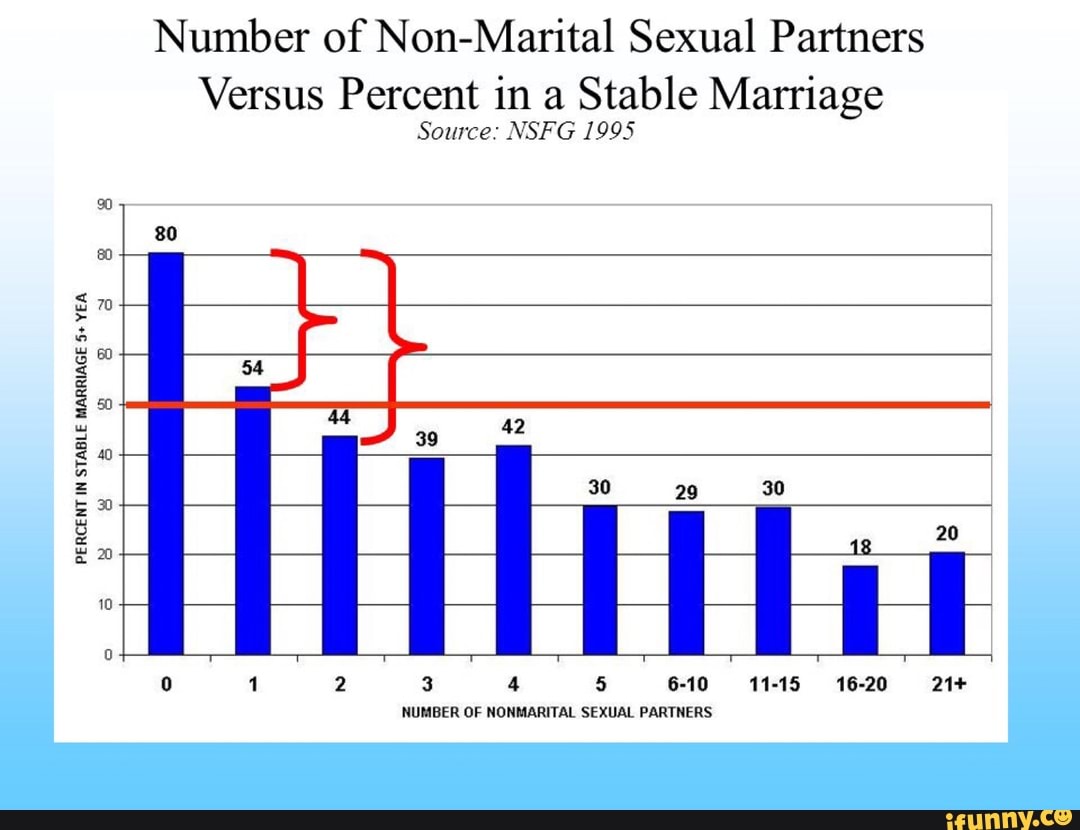
Between the above post, and this post, not good if you read why this is occurring (economic security).
"Meanwhile, America’s so-called “marriage divide” is only widening. College-educated and economically better off Americans are more likely to marry and stay married, but working-class and poor Americans face more family instability and higher levels of singleness. For Americans in the top third income bracket, 64% are in an intact marriage, meaning they have only married once and are still in their first marriage. In contrast, only 24% of Americans in the lower-third income bracket are in an intact marriage, according to my analysis of the 2018 Census data."