True that. I have created a bunch of concept maps for my books in order to show readers this graph. It's really useful to find your way in a new field, to keep track of your progress, and also to look ahead into the the concepts that are coming up. Here are the links to the concept maps:
I work alongside different industries and a hobby of mine is getting the people I work with to break down their domain for me. You've given me some good examples for organization, I have a lot of different media but everything would translate to concept maps, but I don't understand the 'graph' term you and OP are using. I found two definitions, neither of which seem like a perfect match.
Is this an analogy? Would I be able to apply the concept to my project if I dug into it?
For example, you have the concept "complex numbers" as a node and it has edges to "trigonometry", "exponentials", "real numbers", which are other concepts that are represented as nodes.
The study is the connections between things, not the shape they make on paper. So not squares, triangles, hexagons, etc. but can you get from one thing to another and how many intermediate ones do you have to go through? Are there multiple paths from here to there, or just one? Which graphs have the same connectivity even when drawn in a different layout? What does it 'cost' to go from one to another (see below)?
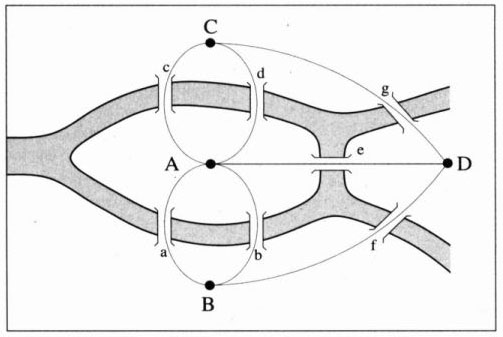
It's used in the classic Konigsberg Bridge problem: https://physics.weber.edu/carroll/honors_images/BarbasiBridg... where the nodes are places in Konigsberg, and the bridges are the connections between them, and the puzzle is asking if you can visit all the areas, cross all the bridges once and only once, and return to where you started.
In the classic Travelling Salesman problem: https://cdn.optimoroute.com/wp-content/uploads/2020/07/Trave... where the salesman wants to visit all the cities, they certainly can use the same route more than once, but what's the most efficient route to visit them all without wasting time and fuel going back to the same one unnecessarily?
Edges can have weights (numbers) on them like this: https://i.stack.imgur.com/ET4ny.jpg which you can use to represent how far the link is, or how costly it is to go that way (fuel cost, or travel time, or effort, or speed limit on the roads, or bus/train/plane ticket price) and then you can ask the cheapest way to visit all the places, or the shortest way, or the fastest way. So it can be used in route planning (I want to fly here to here, via somewhere, what are my options?)
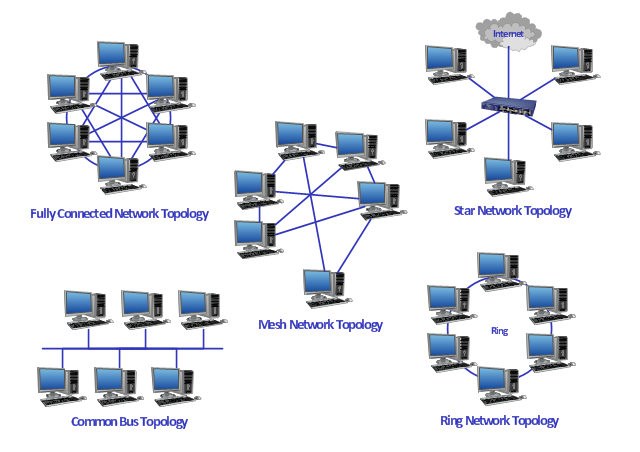
Because it's about connections, not location or shape, it's very general. It can talk about computer networks like this: https://static.packt-cdn.com/products/9781788621434/graphics... and you can see one choke point in the middle that has to be fast enough to take the aggregate traffic of all the computers on both ends. Or you can look at it for the reliability - that single middle link is a good place to make two links, because then one can fail and all the computers are still working.
Then you can deal with different "shapes" of graph (not layout on paper, "shape" of connections): http://2.bp.blogspot.com/-GW8bGXZNrWg/VmFGCI949QI/AAAAAAAACd... does each node connect to every other one? Is it sparsely or densely connected? How many links could we lose and leave the minimum spanning tree - the skeleton network where everything is still connected end to end by one link? Is there one critical link which would separate it into two disconnected parts? What's the worst case for any two nodes? What if one link fails, what happens to the best and worst cases?
It can describe "shapes" of communication or organisation - military has a top-down structure, anarchy has a meshed everyone-to-everyone structure.
Graphs can be directed, edges can be one-way, they can be used in project planning, nodes can be tasks and edges can be which task output feeds into the next task input, and tasks and edges can weight how long things take: https://2.bp.blogspot.com/-SHnStluEIPc/WkarHINi08I/AAAAAAAAQ... then you can ask what things you can arrange to do at the same time and what you can't. In the picture there's a 3 day task waiting on a 4 day task. No matter how quickly you do all the other tasks, the whole thing must take 7 days minimum. This comes round to computing and how quickly you can speed up a program by adding multiple-processors. If there's a chain like that, only speeding up that chain can help, nothing else can help.
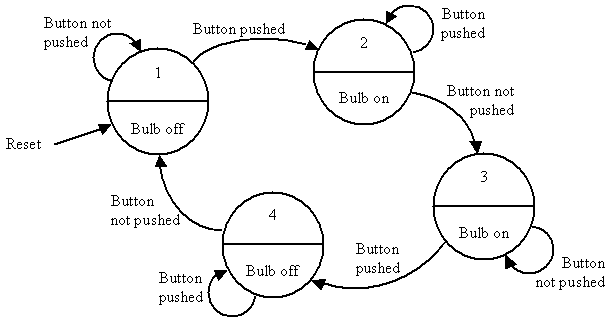
They come into computing, tree structures are connection graphs, regular expressions are state transition graphs, concurrent programming is about tasks you can do at the same time, the internet is a connection graph and routing is finding short paths between distant computers through other systems.
Neural Networks are about connection graphs - each node is a neuron holding an activation value and when it triggers, it sends some activation out to the neurons it's connected to. If the combined input passes that neuron's activation value, it does the same. Somehow by adjusting these trigger values and feeding a prepared input in (pixel values from a photo, one value to each input neuron) it triggers a cascade of activation through the whole network, and it settles on an output high for a picture of a dog, low for anything else.
And concept maps, knowledge graphs, can be modelled like this; which ideas are connected to other ideas? When learning something it can help to make dense connections - instead of trying to remember that "shoe" is "zapato" in Spanish as a plain word connection which will be easy to forget, try and have it in a sentence about how your shoes are pinching your feet, and one about the smell of leather shoes, and one about the slimy feel of shoe polish, and a visual memory of the nearest shoe shop. More dense connections give you more ways to access that memory, more redundant, more easily, and using the mental connections reinforces them.
Note taking tools like Obsidian, Dendron, TiddlyWiki, and systems like Zettelkasten are working with the problem "when I've taken notes, I can never find them, and hardly use them", and saying you need to connect the notes to other notes, more connections, then you see one and it gives you ideas by seeing what it links to - last time you used this note, what else were you thinking about?
Wikis are graphs, HyperText (web) links make a spider's web of connections between pages.
This is the "graph" in Facebook's "social graph" - who knows each other, how do they know each other, how strong are the connections between people? You know one person as a coworker, another by being in a hobby group, another is an extended family member and a close friend, another your phones both see the same WiFi access points so you must live or work near each other.
It's so general it comes up all over the place; how do decisions get through your company from the people who make them to the people who need to hear them? How does Google Maps find you a good route? How do you deliver post around the country moving it from regional post office to central sorting hub back to regional delivery office? How does an AI path-find a route in a computer game? Which routes do you send trucks and cargo ships so they avoid making a return journey carrying no cargo, or never go via a bridge they can't go under? How do you build a country-wide telephone network without bankrupting yourself trying to run a copper wire from every person to every person? How do you represent the connections in your supply chain from company to company so you can avoid a 'chip shortage' event and have redundant suppliers if one of them has problems? Where does the water in the heating system need to go to get to all the radiators? Who is only six degrees from Kevin Bacon, where people are connected by appearing in the same film as each other? Who has the lowest Erdos number, where people are connected by being named in the same math papers as each other? If someone watches a VSauce YouTube video, which channels might they be interested in being recommended?
Holy crap. Thank you for this. Not only the math reference, but the great examples of knowledge visualization. It's something I've been obsessing over recently.
Math is “regular” enough that you can get away with using math at a higher level than one understands. All “practitioners” are using fringes of math they barely understand, which is ok — book says Theorem XYZ guarantees. But that’s also where your mathematical growth is stunted. Learning “higher math” is always standing back a little.
The epitome of this is the feared Real Analysis class where many people realize they’re pretty much incapable of understanding high school calculus. But it keeps happening.
Yup. It’s not about taking the quickest route from a to b, like textbooks try to do (no doubt to save paper) but to “fill in” the mental graph in your head as fully as you need.
If that means solving the same problem multiple times using different methods no matter how useless or inefficient, trying things without knowing if they’ll work, and adding to your bag of tricks for later problems.
Last time I took math courses was high school, algebra 2 or geometry. Do you have any resources you can suggest for not only going forward but also filling in the gaps that I've forgotten or never filled?
disclaimer: self-promotion ahead, highly relevant but still...
> RE: resources for filling in the gaps
I recently published a book titled No Bullshit Guide to Mathematics that has precisely the goal of reviewing concepts form high school math for adults. Context: I was a private tutor at university for many years, so I know how common it is for university students not to remember anything from high school and struggle a lot, even though a few weeks of review would bring them back up to speed.
Once you have the high school math review done and solved some exercises and problems, you'll be in good shape for the other two books in the series No Bullshit Guide to Math & Physics, which covers mechanics and calculus, and the No Bullshit Guide to Linear Algebra. You can easily find links if you search for them and see reviews on the amazons.
My advice for high school and lower level college maths is to 1) pick a good book 2) solve all the problems. A good way to accomplish that well is to start at the lowest math that is possibly non-trivial for you. Otherwise, you will hit a wall by skipping past your comfort zone and struggle, which is where you need an instructor to “save” you. You don’t want to build a castle on rocky foundations.
It’s like lifting weights. If you start at a weight that is hard, you’ll probably struggle to learn good form.
The hard part about math is that math relates to the real world - it’s why we study it. Yet, instead of being empirical, it’s produced by almost pure logic plus some magical axioms and definitions revolving around things that don’t actually exist. The pure logic is easy enough and the empirical/practical part isn’t so bad, but it’s really unclear how or why the two relate so conveniently
Eg, everything we know about linear algebra comes from arbitrary definitions and axioms that were chosen so that the operations would have real world use. Outside of math, this is called fantasy, scamming, religion, conspiracy theory, etc. It isn’t a good way to form ideas except when it’s math, and it’s really unclear why the results of this practice can help us send somebody to space successfully
A professor once told me that math isn't a spectator sport - if you can't get your hands dirty and do it then you don't understand it - and it stuck with me and encouraged me to always find examples to learn.
> These definitions, which are not at all simple for the
> beginner, came to be used in the wrong context.
> Textbooks presented them before any explanation was
> given of the theory and its applications, there
> by complicating an understanding of things that
> were intuitively clear.
hear hear!
This problem is like most of the Wikipedia pages that I come across on 'complex' topics of not just maths but anything remotely intersting technically. I just give up in the end. Life is too short to be bothered with some editor's 'dick measuring' competition about how clever they.
Fully agreed. Maths topics pages on Wikipedia are useless for 99.9% of population. They just bombard you with alien phrases and concepts with zero explanation of what's what.
Having read numerous books on various aspects of mathematics written by the academia, my pet theory is that there are two kinds of people who write incomprehensible math books:
- Senior professors who actually suffer from the curse of knowledge and really forgot how it is not to know certain things, so they make tons of assumptions that are obvious to them.
- Junior profs who could actually explain the topics in an accessible way but do not feel secure enough and engage in a strange game of showing off. I know the same people could do a good job in the classroom, but once they get down to writing, they start to be afraid of being judged by their Senior colleagues so they follow the trodden path.
I gather the books that don't fail into these two categories for my daughter so when she grows enough to be able to grasp these concepts, she won't have to do dig through tons of crap.
I recognize your two categories of bad math books and would like to add a third: commercial textbook publishers "padding" the pages with filler. It seems every book made for first-year undergraduate students is 10x thicker than it needs to be: there are these huge color images and lots of repetition, which makes students just tired and not want to read the book.
It's completely artificial padding and unnecessary: you can teach calculus in 100 pages, you don't need 1000 pages (cf. Silvanus Thompson book on calculus or my books). I think the padding is done to make the exorbitant price tags seem more reasonable, so this is why I'm optimistic about this book since it's coming from the Eastern Block (no padding).
I appreciate your No Bullshit guides a lot! Especially the fact that you provide the solutions to the exercises so that they're perfect for self-studying. I can imagine someone might like to have hundreds of color images - the assumption is they can help in absorbing certain concepts by linking imagery with abstract ideas.
My objection to this argument is that it seems to present "comprehensible" as the default outcome, and then derive confusion as a result of problematic thinking.
Anyone who has actually tried to teach students knows this is false. Merely trying to be understood fails with high probability. The average math or physics grad student upon entering already knows more than they have any chance of explaining thoroughly; distinguishing between senior and junior professors puts that line much further away than it really is.
It's plausible that a sort of follow-the-template dynamic entrenches bad pedagogy, but I would think that the reason authors defensively stick to the old patterns is not because they worry about being judged, but rather the concern that they will do students a disservice if they are not "better than the Beatles":
In other words, rather than risk being blamed for using a progression that works poorly, it's safer to follow the old patterns, so that tradition is blamed instead — nobody ever got fired for teaching IBM^W the geometry sandwich.
OK, a fair point. Let me be specific. What I consider a good math book for undergraduate students should have the following:
- Explain the reason first instead of jumping into the definition straight away. I'm not taking about applications in physics etc., just a simple sentence like, "We have to learn series first in order to understand limits, and limits are necessary for understanding differentiation." Just one short sentence is enough to create a map in my mind and actually give me a decent reason to learn the topic. Seems obvious? Most math books chapters start with a definition.
- Give examples. Really. How am I going to even remember the topic if you have failed to give even one example?
- Give exercises for self-study. This is where the actual learning happens: at this point I can text whether I understood the theory or not. Moreover, it is through exercising that retention happens. Without exercises I can force myself to learn 50 pages and have only a vague memory of it the next day.
- Provide the solutions to the exercises. I get it, if it's a textbook, you want to separate them - that's fine. But not providing them at all means the books is only half-useful for self-study.
If a book has all these, I already consider it decent enough. Additional points for explaining particularly difficult points in more detail (good profs know well where their students are lost most often). If it makes sense, providing examples of practical application in sciences is always useful as it gives me some mental anchors connecting ideas and helping them to stick.
Sure. I feel that many contemporary undergraduate/college textbooks are actually fine in this regard (like Topics in Contemporary Math by Bello, Britton, and Kaul). As for the rest, some of my favorites:
- Warner, Pure Mathematcis for Beginners
- Devlin, Introduction to Mathematical Thinking
- Stewart, Concepts of Modern Mathematics
- Herrmann, Sally, Number, Shape, and Symmetry
- Baylis, What is Mathematical Analysis?
- Feil, Krone, Essential Discrete Math for Computer Science
- Rotman, A First Course in Abstract Algebra with Applications
- Banjamin, Chartrand, Zhang, The Fascinating World of Graph Theory
- Zou, Mult-Variable Calculus: A First Step
- Hubbard, The World According to Wavelets
- Sayama, Introduction to the Modeling and Analysis of Complex Systems
- Darst, Introduction to Linear Programming: Applications and Extensions
- Sourin, Making Images with Mathematics
- Gallian, Contemporary Abstract Algebra
And many others. Of course, all such lists are completely arbitrary. Once I get familiar with a certain topic, elaborate explanations seem redundant and I feel like shouting, "Get to the point already!" - whereas the same explanations can be extremely helpful for a beginner.
That is an amazing book. I will also recommend "A walk through combinatorics" by Miklos Bona for simple explanations and well made exercises with solutions present in the book itself.
"Hover to define" on all terms in formulae on Wikipedia would go a long way toward fixing that problem.
Not completely, because they'd still all read like they were written by a math grad student who's trying to impress their peers rather than communicate clearly. But it'd help a lot.
Hm. No. Wikipedia pages on advanced mathematical concepts are intensely useful, frequently more so than any other single text you could find on the topic, because the only other way to obtain the same information would be to scavenge it paragraph by paragraph from a dozen or so textbooks, some of which are on apparently unrelated and/or even more advanced topics. (I’ve had to do this, multiple times, and it can take months and an absolutely unreasonable tolerance of frustration fueled by either youthful naïvety or sheer boneheaded arrogance.)
But that’s provided your general mathematics education is something like one or two semester-long courses away from the thing you want to learn. Otherwise, they’ll frequently be useless, and you’re better off turning to gentler introductions.
Wikipedia is not unique in this; many other technical reference books are the same, including the Springer Encyclopedia of Mathematics (a rebranded and somewhat expanded version of the Russian-language Matematičeskaja ènciklopedija), probably the best general reference on university-level mathematics ever (unsurprisingly, as a lot of it has been written by then-current or -future stars of Soviet mathematics, that being one of the few legal ways to earn additional money while holding a job in academia). Few references are good introductions. You don’t learn C from the ISO standard—or even Scheme from RnRS, as wonderfully written as the latter is.
I am quite literally furious over an accusation of a cleverness contest in a source the quality of mathematics Wikipedia ... But to direct this fury at you would be both wrongheaded and useless. Only, any environment where this kind of behaviour exists at all, in any way, is best exited as soon as possible and forgotten about. It’s just that if you happened to suffer such an environment previously (possibly unwillingly, such as in school), you may see signs of this even where there are none. The best way to avoid this false impression is probably to look not at whether some people (appear to) flaunt their knowledge, but whether others are scorned for not having such (to be distinguished from scorn for being unwilling to learn).
Pure mathematics departments are generally among the friendliest places I’ve been to, if you just show up with a question (and display signs of having tried to find an answer by yourself, even if the result is a completely arse-backwards, mangled parody of the subject). Applied mathematics departments too, by and large, but there’s a small minority of them where people are jaded by having to teach unwilling students and justify their existence to narrow-minded bureaucrats, so unfortunately I can’t just recommend them unreservedly.
This very book (but in russian) is the source of all my math skills. Academic Zeldovich was a brilliant physicist and I am glad to know what his works translated to English
The crucial question is, is the text any good? My bias tells me it's next to impossible (but not actually impossible) for a text from 1987 to be 2021-beginner friendly, especially in a field like mathematics.
I haven't worked through the book yet but looking at the authors, Yaglom wrote some great Math books and Zeldovich was an absolutely genius in the field of theoretical physics, so it probably is.
As a German living in the Western part, my math teacher would always rant how much better the East German math books were. Math and science education in the Soviet Union and the Eastern Bloc was and still is vastly superior to anything we had or have in the West.
Having the same background, I often heard this praise too, though mostly for Soviet works. But every time I followed up on it, I found that even the introductory level books dug right into the depths without much explanation. They might have been good in rigor or depth, but I found them very lacking didactically.
Maybe I looked at the wrong ones. Your link seems to suggest that it's different for textbooks aimed at young children.
Can you give me some examples of good East German higher math or physics books? I'd like to have another go at it.
Unfortunately I wasn't really that interested in math when I was a student, I just remembered the ranting of my math teacher. I think you can still get quite a few on Ebay but I fear that not much has been digitized. I can recommend a few Soviet works however that are more introductory level and that I have worked with myself.
Actually my view is the opposite. Older math books has a lot of practical examples.
It seems like in the 90s and 2000s a lot of math books started being written by pure mathematicians who don't care about the applications of mathematics.
My understanding is that in the 90s and 2000s publishers started realizing that they could sell bare bones textbooks and then sell those problem examples in compendiums, effectively double dipping on each student.
> In addition to well-explained solutions, this manual includes corrections and clarifications to the classic textbook Linear Algebra, second edition, by Kenneth Hoffman and Ray Kunze.
I think this is actually fair; even Strang, after all, provides answers to only select problem sets (e.g. only odd problem sets in Linear Algebra if I recall correctly) though to be fair to Strang, it seems to me that in his case, it's more a matter of "if you are unsure, come and ask me" and probably not the case of maximizing profits.
Why would you say that? The kind of mathematics that book presents has barely changed in the last 200 years. I would doubt there's much difference to speak of at all.
Because while the field of mathematics has probably not changed, the field of didactics has changed drastically, and the student expectations in 1980s and 2021 will be also drastically different.
Has it actually improved though? Every study I've seen says students are worse at maths today than 30 years ago, so to me it doesn't look like all that pedagogy research improved things. If things actually got better we should have strong evidence supporting that. Images are prettier, sure, but do students who study using modern books actually understand the material better after the course is done?
I think attention spans have shortened (which is arguably devastating for maths), and the materials considered "state of the art in modern pedagogy" are the ones that take that into account in ways that a book from 1987 does not.
As someone who had a hard time focusing in school, modern books with lots of text actually made it harder to focus than books with less text and more information per word. I can read 20 words and then think about those, I can't read the same information if it is spread out and hidden within a 2000 words text.
So maybe kids has problems focusing partially due to modern pedagogy? Every word you write down has a cost to the reader, and the less attention span the reader has the more that cost matters. Drown them in too many words and they will just zone out since their attention span didn't last long enough for them to reach the important parts of the text.
Drill exercises require very little attention time but are the keybto learning a topic and understanding it. This is nothing new but it is usually despised because “boring”…
Not so much with respect to Maths: either you integrate volumes or you do not, and the theory is essentially “dumb”.
As long as you know what a derivative is, all integral and vector calculus is just a comination of “look at the problem with an infinite loupe and then add all those values “.
DiffEq is more or less similar.
Classical maths was very well taught: examples and applications galore.
I doubt math professors who write textbooks that are not meant for the mass public (i.e. not part of a state mandated curriculum) follow the field of didactics.
I've read math textbooks from the 60s onwards. I do not see a trend vs time.
Classical books are usually much more engineering oriented than modern ones, with many more applications.
The thing is that most applications are just ordinary things: tou are not going to go much deeper than angular momentum and/or the Stoked-Gauss theorem for electric-magnetic fields.
"Higher math" is a very broad concept now, you would need thousands of pages to cover it. This books is basically calculus with applications written in an accessible way by known experts and without confusing mistakes.
This is a good book. It would be even better if it were typeset in LaTeX.
I wonder if such an effort could be financed from some kind of microgrants. Take old Soviet maths and physics books - they were very good! - translate them into English, possibly with small alterations (e.g. a QR code link to an animation), type them in LaTeX or AMSTeX and release them under a friendly license.
If it was a Western book, definitely, but with books published in the 1980s in the USSR, I am not sure how it works.
The USSR was not a signatory to the Berne convention, so the original rights may be lapsed. Russia joined the Berne convention in the 1990s, but there were some reservations agreed upon that limited the retroactivity.
I think only Russian IP lawyers can answer that question with any precision.
Z-Y is a fantastic book, especially if you have a decent math education already. Soviet style math and physics education - if done well- teaches you how to think with math, i.e., mathematics as an augmentation of the human intellect in the Engelbartian sense. Somewhat paradoxically, it's a humanistic approach to mathematics education.
PS: https://mirtitles.org/ is a treasure trove for people who like books from the Soviet Era.
Context: I have a PhD in physics (many years ago), work in industry since then and have two high-schoolers I help in maths.
I clicked on the link, the book opened on page 500-something and I said "oh fuck" loud when I saw the mess of equations. I actually thought that the rendering failed.
I then moved back and the book has some down-to-earth approach but I could not stand the block of text page after page. It is truly a horrible book to learn from.
given your lengthy experience and qualification i am surprised that typesetting is such an issue for you. perhaps the book might be helpful to you as a teacher to draw some material from. me personally, trying to recall my attitude and focus during high school, i don't think i would have minded this book at all
I think in the Soviet bloc, "higher mathematics" referred to mathematics taught at higher institutions (i.e. universities or technical institutions at the same level). This usage is a bit different from that in the Commonwealth of Nations (see https://en.wikipedia.org/wiki/Further_Mathematics for instance). As for the current text, while it does mostly cover high-school calculus, some portions of it (e.g. contour integration, analytic functions and Dirac delta function) are definitely outside high-school curricula. As the authors indicated in the preface, the intended audience of this book include high-school students, high-school teachers and first-year college students.
There really isn't any universally accepted definition of what "higher math" means. To mathematicians it seems to be something of a synonym for "proofs based maths", but for the rest of us, plenty of people use "higher math" to refer to Calculus and up. But in that sense, "higher" will always just be relative to where you already are, so honestly it's not a particularly useful term. But personally I don't think it's anything worth getting to worked up about.
The book in the updated link [1] does not have the problem that the old link had I think, if you were talking about how for example on page 358 the page had become split so that the rightmost part of the page had been cut off and placed on the left side of the page. I didn’t check the other pages because I’m on mobile, but since page 358 looks good in the new link the others might too.
Sounds like a pretty straightforward question to me. There's no reason to be defensive about flaws in a math book scan, even if it's largely a cool thing.
He edited his comment. Substantially. The original comment told people that because five pages were missing, "either do it right or don't do it at all." That was basically all he said. Great guy, getting me flagged by completely changing his response without acknowledging there was an edit.
Wow, sorry to hear that. Obviously, when it comes to technical information, something is better than nothing.
It's good to know if something's missing so you can go find it, but of course anyone would rather have half a nonfiction book than no book at all, because that still has value.







It's basically one big graph of concepts.
The tricky part is, most beginners simply don't know how to navigate that graph.
They see complex numbers with their exponentials and cos/sin forms and shut down.
They can learn all these concepts no problem, but finding what they need to learn defeats them.